
Nvidia: four, black, even and low

October 6, 2026
If you've ever set foot in a casino, or seen any movie where a group bets at roulette, you'll surely recognize the lingo. When the ball stops on four, the croupier calls out four things: the number, the color, whether it's even or odd, and which half of the layout it belongs to. Four, black, even and low. Whoever put chips on four, on black, on even and on low collects on all four, and may well get up from the table convinced they had diversified. But in reality they hadn't. They had a single bet, spread over four squares.
That's the image that comes to mind when I look at what Nvidia is doing. It sells the chips, invests in its customers' equity and guarantees data center leases. Until August it also shared revenue with the small clouds that rent out its GPUs, but it paused that because its own employees feared trouble with antitrust regulators. Three bets, to which it adds a fourth: it now also offers to back the residual value of the chips, for up to 25% of each deal, in projects financed by Apollo, BlackRock, Blackstone, Brookfield, Goldman Sachs and KKR, which aim to mobilize more than 500 billion dollars of third-party capital. Four live instruments and, in reality, a single bet. They all pay out if demand for compute stays ahead of supply, and they all lose if it slows down.
Betting against its own curve
Of the four instruments, the last one deserves a careful look, not only because it is the newest, but because it contains an internal tension.
A residual value guarantee is a bet on what a used chip will be worth some time from now. Let's start from one idea: a chip produces computing capacity, and the price of reaching a given level of capability has been falling since 2023 by around 47% per quarter, according to the report Epoch AI published at the end of September. As Pep Martorell pointed out a couple of weeks ago, that's faster than electricity, batteries or DNA sequencing fell at their best.
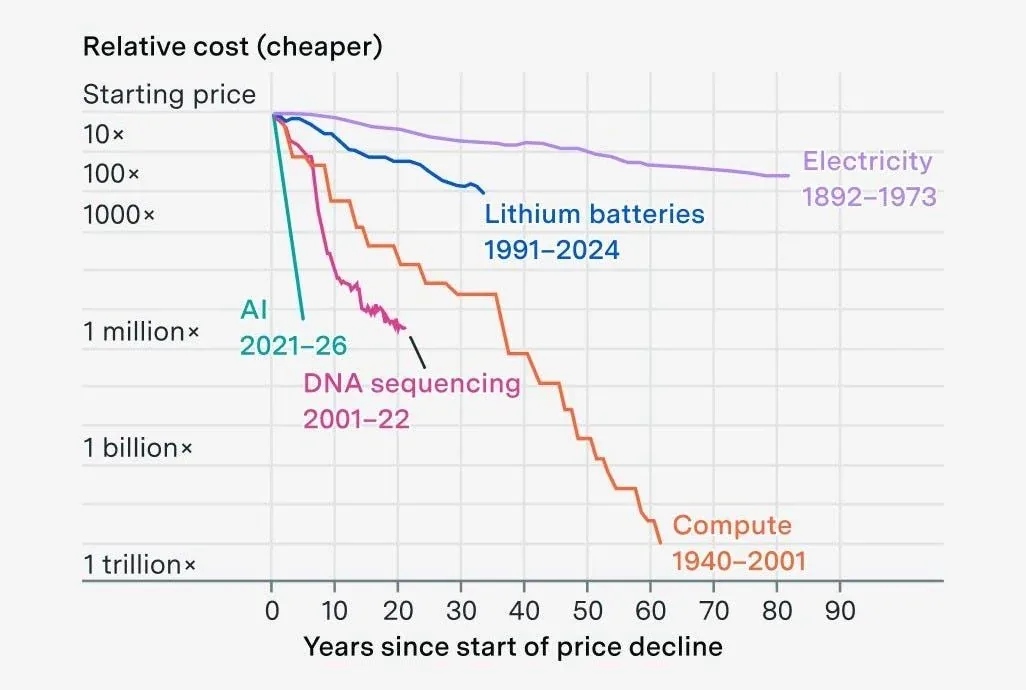
Source: Epoch AI (CC-BY), 2026, via Pep Martorell.
In fact, it's the industry's favorite argument: since AI will keep getting cheaper, it will reach everywhere quickly. But there's a nuance about those same data that some independent analysts are already suggesting: AI isn't getting cheaper because it's especially efficient, but because of the sheer amount of money being thrown at it. In other words, the curve that justifies the investment is paid for by the investment itself. And it's not the first of the circles we've been pointing out.
And be careful not to confuse two curves. Epoch measures what the result costs, not what the machine is worth: that decline includes the hardware, but also algorithms, competition and pricing policy. An old chip can remain useful for less demanding workloads, and that is precisely the argument of those who defend these guarantees. But the one who built the bridge between the two curves wasn't me; it was a certain Jensen Huang in March 2025, when he unveiled Blackwell and warned that, once it shipped in volume, you wouldn't be able to give the previous-generation Hoppers away. So the tension is obvious: Nvidia sells its customers a dizzying cost-decline curve and, at the same time, asks creditors to treat that same hardware as durable, predictable collateral. If the money keeps coming in, the threat is obsolescence. If it stops coming in, it's overcapacity: there will be GPUs to spare and their rental prices will collapse. Both things can turn out fine, but the pace has to be exactly right. Meanwhile, of course, Nvidia collects the premium on that insurance up front, in the form of orders.
So why does it do it? Because a guarantee is one of the cheapest ways to tell a lender "I trust my product." It's more credible than a press release and far cheaper than cutting prices. There's no need to assume Nvidia is faking anything. It's enough to observe that its CEO stated publicly that the previous generation of chips couldn't even be given away, and that his company now guarantees what this generation's will be worth. I don't know whether it's cynicism or simply a division of labor between the stage and the finance department. Judge for yourself.
But the formula isn't new either. In 1999 Lucent was the largest telecommunications equipment maker in North America, with revenues of about 38 billion dollars. To keep growing, it ramped up loans to its customers so they could buy its equipment. By September 2000 that loan portfolio had reached 8.1 billion, much of it granted to alternative carriers such as Winstar or ICG, which ended up bankrupt. By 2002 its revenues had fallen below 12 billion, and in 2006 it ended up merged with Alcatel. The difference with Nvidia is one of technique, not of logic. Lucent lent out of its own pocket, and the risk sat on its balance sheet. Nvidia doesn't lend: it guarantees so that others will lend, and the risk is spread between private credit funds and footnotes. It's more elegant. And a good deal less visible.
A few months ago I wondered here whether Nvidia might be the new Kodak, and whether its product would survive the next technology curve. Today's question is a different one, and stranger: whether its balance sheet has become a product. The balance sheet used to be where risk was measured. Now it's being marketed. Some analysts are already calling it balance sheet as a service.
But what all this reminds me of most isn't Lucent. It's a bookstore.
Four hundred against fifty
On December 16, 1998, with Amazon stock trading at 240 dollars, Henry Blodget, a little-known analyst at CIBC Oppenheimer, raised his price target from 150 to 400 dollars. That same day, hours later, Jonathan Cohen of Merrill Lynch rated the stock a sell and valued it at 50, arguing that Amazon would never reach the earnings Blodget was projecting. Within three weeks the stock topped 400, and shortly afterwards Blodget took over Cohen's seat at Merrill Lynch. It seemed the argument was over, and the optimist had won it.
Cohen, incidentally, would also turn out to be right: after the 1999 stock splits, his 50 dollars was equivalent to just over 8, and Amazon fell below that in 2001. But on Wall Street, calling it two years early turned out to be worse than being wrong.
In reality, the debate had only just begun. And what came next had nothing to do with valuation.
In early 2000, Amazon's new CFO, Warren Jenson, decided the company needed to shore up its cash in case suppliers started demanding to be paid sooner. His advisor at Morgan Stanley recommended going to Europe for the money, and in February Amazon placed 672 million dollars in convertible bonds there. It didn't come cheap: it paid 6.9% interest and accepted conversion terms much worse than in previous issues.
But the timing was providential. The Nasdaq peaked on March 10. Three weeks after that issue, the deal would no longer have gone through. Brad Stone, the company's biographer, maintains that without that cushion Amazon would almost certainly have faced insolvency the following year.
Shortly afterwards, in June 2000, a young Lehman Brothers analyst, Ravi Suria, published a report that wasn't about Amazon's value, but about whether it could repay what it owed. He described its credit as "extremely weak and deteriorating" and predicted it would run out of cash within four quarters. The stock fell 19% that day, as a prologue to a decline that would end up exceeding 90% from its December 1999 high.
The difference between Blodget and Suria lay in the question. Blodget asked how much Amazon would be worth, while Suria calculated whether Amazon would still be alive by the time it reached that valuation. One is a shareholder's question. The other, a creditor's. I know it sounds absurd that both could be right at the same time, but they can, because they are answered on different time horizons.
I had to choose between those same two questions without even knowing they existed. I joined Terra in April 2000, a few weeks after the stock hit its peak of €157.65. To secure my contract, they offered me a stock option plan, with the share price already around 80. It had fallen by half and still seemed an absurd price to me, so I didn't waste much time debating the plan: I preferred a conventional senior executive severance package. Without knowing it, I had traded the shareholder's question for the creditor's. I don't tell this to boast about my instincts, but because of what came next: in May 2003, Telefónica offered €5.25 for each Terra share, and in 2005 the stock was delisted at €3.04. Sic transit gloria mundi.
Two floors in the same bank
Twenty-six years later, those two questions are once again living under one roof. Morgan Stanley keeps Nvidia stock at overweight, with a price target of around 300 dollars, up from the current two-hundred-and-something. And on August 24 its credit team initiated coverage of the same company with a neutral recommendation. It warned that conventional leverage no longer reflects the real risk, because Nvidia's support for its ecosystem has shifted toward new, off-balance-sheet instruments. It estimates that its total credit exposure will be around 200 billion by the end of 2028, of which some 170 billion won't appear on the balance sheet. The new Blodget and Suria, on different floors of the same bank, covering the same company, a few weeks apart. Will they say hello if they bump into each other in the elevator?
And here's a curious twist. The Morgan Stanley advisor who in February 2000 recommended that Amazon go to Europe for those 672 million was named Ruth Porat. Back then her bank helped Amazon survive Suria's report; today that same bank is playing Suria to Nvidia. Porat, by the way, later spent nine years as CFO of Alphabet. Precisely: the company that in the second quarter of this year recorded negative free cash flow for the first time, because its investment in AI infrastructure now exceeds the cash its business generates.
The house always wins
Who was right? All of them, each in their own way. Blodget took three weeks to be proven right, and in the long run he hit the bullseye again, as a consolation prize. Suria got the diagnosis right, because the stock sank, but missed the outcome: Amazon didn't run out of cash, thanks to the 672 million from February. Amazon didn't need to be right. It needed to have cash, and it got it three weeks before the market shut, however expensive it seemed at the time.
Nvidia will almost certainly survive too, and with far more breathing room than Lucent. Morgan Stanley's own stress test concludes that, even with growth stalled, its leverage would stay at around 0.7 times, and it projects net cash of about 520 billion. Against that, the maximum liability the bank estimates from the residual value guarantees, some 90 billion in the worst-case scenario, doesn't sink a company like that. Nvidia is not the player who has spread chips across the layout. It looks far more like the casino's house, which doesn't need to guess right: all it needs is for the zero to exist.
The ones who didn't survive in 2001 weren't those who bet on Amazon, or those who bet against it. They were the ones who had bought with borrowed money and needed it to be worth 400 dollars on a specific date. Nor did Lucent's customers survive, having bought equipment with money that existed only as long as the party lasted.
As back then, the ones at risk today are the small clouds financed against GPU rental prices, the private credit funds lending against that same collateral and, without knowing it, many companies that have nothing to do with chips.
Because, watch out: a Spanish company that signs a multi-year consumption commitment with a cloud provider, or that builds a critical process on the specific model of a provider whose pricing is subsidized, isn't just buying compute. It is accepting, without seeing it, part of the financial, technological and counterparty risk of whoever is selling it. Knowing this isn't distrusting AI. It's not confusing the market's appetite with the counterparty's solvency.
So the question I leave you with is simple. Have you asked your AI provider yet how much it will be worth, or whether it will still be alive to be worth it?
This article is part of a series that began with "Less Wood, It's War!", and continues with "The end of the token open bar, or something more serious?", "What if the Genesis Mission were a huge mistake?", "Where's the pea?", "From packet to token, and back to square one", "Investing in typewriters", "Will the "killer app" arrive in time?", "Are they making room for us?", "Spot the 8 differences", "Will AI end up in a backpack?", "Will Nvidia be the new Kodak?", "Is CUDA Nvidia's magic potion?", "Neither conscience nor consciousness", "Neither Hawking nor Einstein. The true origin of intelligence", "Yogurts and tokens: welcome to the AI confusopoly", "The mathematician who left mathematics. What will we leave behind?", "How high is your fence?", "Will the new Encyclopedia be European?", "Find "digital transformation" and replace with "AI"?", "It's always day one", "Would you hand your wallet to Zuckerberg?". To be continued...
Our latest news
Interested in learning more about how we are constantly adapting to the new digital frontier?
Corporate news
October 7, 2026
Sngular grew by 7.2 per cent in the first half of 2026
Strategy
September 29, 2026
Would you hand your wallet to Zuckerberg?


Insight
September 17, 2026
The Role of Junior Professionals in the Age of AI: Perspectives, Challenges, and the Future of Talent in the Tech Industry