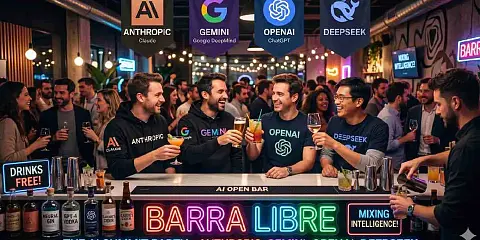
The end of the token open bar, or something more serious?

April 27, 2026
This morning, in an internal forum at Sngular, a colleague warned that Typeform (a popular tool for building surveys and forms) is going to remove a feature that until now came included in its plan. The automated follow-up messages that fire when someone completes a form are becoming "tokenized". They are no longer part of what you get by paying a subscription, and they now cost according to how much they are used.
It's curious how the use of words in technology shifts as some emerge and others become less relevant. The "token" was the yardstick of the crypto world, but it is mutating because of the artificial intelligence industry. That is what the industry calls its minimum unit of consumption. When you ask your AI for something, a machine chops your request into tokens, processes them, and charges you for them.
And it's not just Typeform. Only a few days ago, Anthropic launched the latest version of its most powerful model, whose new processing system can generate up to 35% more tokens for the same text than its predecessor. The price per token hasn't gone up. The bill has. Such is the magic of self-managed inflation.
Interesting, isn't it? What until recently was AI engineers' jargon is becoming the economic logic of the software we use every day. Typeform is tokenizing its automations. Artificial intelligence platforms charge per token consumed. Microsoft has added a credit system to its Copilot on top of the base subscription. And all of this is setting a trend. Over the past year, the number of SaaS companies offering credit-based or usage-based pricing models has more than doubled.
We are saying goodbye to a model that lasted more than two decades: you pay a fixed monthly fee, and you use as much as you like. It worked when the marginal cost of serving one more user was negligible. But when behind every feature there is a call to an AI model that consumes real and growing computing resources, the flat rate stops being sustainable for whoever offers it. Someone has to pay for the tokens, and that someone ends up being the customer. At least once the companies fighting for control of the market have finished killing each other off, and only the two or three winners of the AI wave we are immersed in remain. Because, for now, the ability to "hold out by giving it away" can make the difference between gaining market share and becoming irrelevant.
For the executives of the companies that use their services, the consequence is uncomfortable: the cost of their software tools is no longer predictable. It's no longer enough to know how many licenses they have; they need to understand how much each process, each automation, each query to an AI consumes. Gartner estimates that in 2026, 70% of vendors will prefer usage-based models over classic per-seat pricing. If the prediction comes true, we are witnessing the biggest transformation in software economics since Salesforce invented SaaS a quarter of a century ago. Like many others who were there, I can't help feeling a certain bewilderment at this round trip. Because we remember well that it was the arrival of flat-rate Internet plans that killed the old telecommunications model, the one in which you paid by the minute and by distance. When the cost of transmitting one more packet became negligible, flat rates swept everything aside, and with them was born a whole generation of software companies that inherited that very same logic: pay once, consume as much as you like.
Well, artificial intelligence is undoing exactly that. Every inference, every response from a model, every automation has a real and growing computing cost behind it. The token gives back to software what the IP protocol took away from telecommunications: a marginal cost that cannot be ignored. And with it, the need to charge for what is actually consumed.
Twenty-five years to get there. Another twenty-five to come back. In the end, what changes is not just who installs the meter but, above all, that they're putting it back on us.
Our latest news
Interested in learning more about how we are constantly adapting to the new digital frontier?
Corporate news
October 7, 2026
Sngular grew by 7.2 per cent in the first half of 2026


Strategy
September 29, 2026
Would you hand your wallet to Zuckerberg?