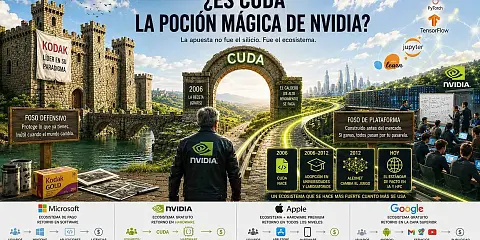
Is CUDA Nvidia's magic potion?

July 7, 2026
The bet Morgan Stanley couldn't read
When I was running Terra Spain, I made one of the most counterintuitive strategic decisions of my career: locking part of our multimedia content inside a "Multimedia Zone" accessible only to our broadband users.
It was a deliberate decoy.
The real bet was the opposite: to build the most powerful open multimedia platform in Spain, so that any user from any provider could access it. We had set up an infrastructure on Real Networks that let us stream live events when nobody else was doing it. The logic was simple: if we filled the portal with video and audio at a time when most people were browsing at a snail's pace, people would feel the need to sign up for broadband. Not necessarily ours. But we had a platform advantage, and we were betting that the market would grow faster than the competition's reaction time.
With that, we forced the other portals to set up something similar without having either the content or the infrastructure. We bought time while we built what really mattered: filling the rest of the portal with open broadband content.
Morgan Stanley analyzed it and concluded that the "Multimedia Zone" was a move to defend the strategic moat against competitors that lacked the backing of a telecom operator. They saw that the value would end up in ADSL, but they swallowed the tactical bait: they believed the moat was the closed portal, when the real strategy was to use open content to accelerate broadband adoption before the competition could react. They looked at the container, not at the network dynamics.
Twenty years later, every time Jensen Huang takes the stage to talk about chips, I think of that. Because Nvidia's real bet wasn't silicon either.
Two kinds of moat
There are two kinds of moat in the tech industry. The one you dig to protect what you already have. And the one you build before you know for sure whether you're going to win, betting that if you succeed, everyone will have to cross your drawbridge.
Kodak had the first kind: chemical plants, supply chains, developing labs in every city, decades of know-how in silver emulsion. An unassailable industrial moat within its paradigm. Useless outside it. As I argued in the previous article, when the world changed, the moat didn't disappear; it became the trap they couldn't get out of. And that's the paradox of traditional moats: they're designed so rigidly to keep anyone from getting in that they end up keeping you from getting out when you need to move to new ground to survive.
Huang bet on the second. And he did it in 2006, when he'd already spent a decade reading the instruction manual.
Three models of moat and a variation
In the nineties, every hardware vendor in Silicon Valley kept a wary eye on the ecosystem that dominated the world.
Microsoft had built the ultimate moat without manufacturing a single chip: a pure software model built on other people's hardware, with returns via licenses. The virtuous circle was perfect: users wanted Windows because it had the applications, and developers wrote for Windows because it had the users. But the masterstroke was that, by standardizing the operating system, Gates forced the entire industry to compete on price to build computers, sending hardware sales soaring worldwide while Microsoft captured the rent in the logical layer. He turned the iron into a commodity and his software into the mandatory toll. Apple lost that war by insisting on controlling both sides of the equation.
Huang designed a different one, but no less effective: a free ecosystem, proprietary hardware, returns captured entirely in the hardware. In Asterix terms: I'll give you the recipe for free, but you pay me for the cauldron. CUDA is free. But if you want to use it, step up to the register and cough up the 30,000 dollars an H100 costs.
Apple, having lost the PC war to Microsoft, didn't make the same mistake twice. Although the iPhone was born in 2007 as a system closed to third-party applications, Jobs corrected course quickly. The following year he launched the App Store, shared value with developers (70% of revenue goes to the creator) and monetized the hardware and the platform at the same time. It was the first model to charge at every level at once, leaving Microsoft irrelevant during the smartphone era.
Google arrived second to the smartphone and built a fourth way: it gave Android away, let hardware become a commodity, and captured the rent in the upper layer: advertising, search, services. The phone maker doesn't pay Google, but Google charges the advertiser who wants to reach the phone's user. Free ecosystem, rent shifted upward. And they secured their primacy in the advertising business by controlling the platform from which everyone started searching.
I don't think Apple took its cue from Huang in designing its moat, but Jensen deserves the honor of having patented the second moat model after Microsoft's original one. That's no small feat.
The water in the moat
But no moat stops the enemy if it's dry. The official story says Huang had the patience of a Zen monk, waiting for the AI market to wake up. The real story, the one in the cash register, is that cryptocurrencies filled that moat to the brim.
Nvidia was born for gaming, but the real financial bridge was Ethereum mining. Its algorithm (Proof-of-Work) required computing cryptographic functions nonstop. CPUs were useless, but Nvidia's GPUs, programmed with CUDA, were perfect. During the bubbles of 2017 and 2021, miners bought cards by the container load.
That brutal torrent of cash flow acted as an invisible subsidy: it funded the R&D for Tensor Cores and Deep Learning libraries when AI still hadn't generated a dollar of profit. And when mining died in 2022 with "The Merge," the water overflowed, flooding the market with millions of cheap second-hand GPUs and putting the CUDA standard into the computers of every student and startup on the planet. The ecosystem was built for free from the bottom up.
The recipe, not the cauldron
In 2006, Nvidia launched CUDA. This free software layer was its poisoned gift: the technical standard that hooks you on a hardware platform with no way out. And almost no one understood the move. Why would anyone want to program a graphics card for anything other than graphics? The market didn't exist and analysts were looking the other way. Nvidia spent years improving compilers, libraries and documentation to solve problems nobody yet knew they would have. But there's always someone who insists on looking at the finger instead of where it's pointing.
And it took the recipe straight to universities and labs. Not to the end user. If researchers learn CUDA, the ecosystem builds itself from the top down. You don't need to convince millions; you need to convince the thousands who train the millions.
While everyone was counting nanometers and teraflops, Huang was building something whose value didn't show up in any chip benchmark.
Six years later, in 2012, AlexNet proved that deep learning really worked. The network built by Krizhevsky, Sutskever and Hinton (do those names ring a bell?) cut the error rate in image recognition from 26% to 15% in one go. It wasn't an incremental improvement, but a paradigm leap. It was trained on two GeForce GTX 580 cards. With CUDA. The ecosystem had been in place for six years when the first wave that needed it arrived.
The competitors didn't lose because their chips had fewer megahertz. They lost because they arrived late to the standard. Once again, the golden rule: the first mover doesn't need to know exactly where it's going; it's enough to move before the others understand there's somewhere to go.
The recipe can't be copied over a weekend
Today CUDA has more than 5 million developers, almost triple the number it had in 2020. PyTorch, TensorFlow, vLLM and every relevant framework assume CUDA as the default. Every academic AI paper publishes code that runs on Nvidia hardware. More than 3,000 optimized applications. Math libraries fine-tuned instruction by instruction over nineteen years.
And yes, AMD has ROCm, which aims to be an answer to CUDA. Compatible in intent, but inferior in depth. It can run the code but lacks nineteen years of accumulated optimization. In large-model training workloads, the gap isn't the capacity of the silicon but the finesse of the libraries that squeeze it.
The cost of migration isn't measured in months. It's measured in years of technical debt and in the cost of convincing five million people to relearn.
Benet Asensio pointed out, in a comment on the previous article, something relevant here: since roughly 2019, real advances in semiconductors no longer come from shrinking the transistor, but from architectures, materials, 3D packaging and heterogeneous integration. We keep measuring in nanometers a world that no longer moves in nanometers. Nvidia's moat is exactly that, seen from the software side: an advantage that no industry metric registered while it was being built. Nobody invests in destroying what they don't even understand.
Still betting, or just growing?
Nvidia spent 12.91 billion dollars on R&D in fiscal year 2025, compared with 8.7 billion in 2023. The absolute figure is impressive. For the record, in my opinion the honest indicator is the percentage of sales, and there the story is less comfortable, because that ratio has fallen below 10% since the AI boom sent revenues soaring. Nvidia makes so much money that its R&D grows in absolute terms while shrinking in relative terms.
What does hold steady is the focus: all that R&D goes into architecture and software, without being diluted into manufacturing. Nvidia is fabless, and its chips are made by TSMC in Taiwan. Which has implications that shouldn't be ignored: the CUDA moat is built on hardware that Nvidia doesn't physically control. If the TSMC chain is disrupted, whether for geopolitical or natural reasons or for lack of capacity, the cauldron disappears even if the recipe remains intact. TSMC is diversifying into Arizona and Japan, but the nodes that matter to Nvidia will remain concentrated in Taiwan for at least another decade. And without ASML's EUV lithography machines (a Dutch company, a global monopoly, which we've discussed in other articles), TSMC can't produce advanced nodes. Europe holds the key to the factory. It just doesn't know yet what it's worth.
In 2026, Nvidia's software bet grew: 26 billion dollars over five years to develop open-weight models under permissive licenses that come close to open source. The logic is the same as Google's with Android: you don't give away the operating system out of generosity. You make sure that every model trained anywhere in the world is trained on your infrastructure.
The competitor nobody expected
But there's a crack in the moat. And it was opened by the least expected party, for the least strategic of reasons.
The United States has spent years restricting exports of its most advanced chips to China. The logic was simple: without access to Nvidia's best GPUs, you can't train the best models. What no one foresaw is that those restrictions created the only lab in the world with a real incentive to build a serious alternative to CUDA. Not out of vision. Out of necessity.
DeepSeek trained its V4 model on Huawei Ascend chips with CANN Next, which is the only ecosystem today that can be called an alternative to CUDA with any seriousness. And the result competes with models trained on Nvidia. The only real crack in the moat wasn't opened by a better competitor. It was opened by a sanction.
And watch the consequences: ByteDance is going to spend more than 5 billion on Ascend chips in 2026. When your domestic market has that scale, the network effect builds itself by force. American industrial policy unwittingly created the only competitor capable of threatening what Nvidia has spent nineteen years building. And the hyperscalers' voracity in what they charge for using their frontier models is leading 80% of American startups to opt for low-cost Chinese models, according to Andreessen Horowitz. It turns out that wearing a revolver on your hip carries the risk that you'll sometimes shoot yourself in the foot.
For Europe, the reading is uncomfortable. It has neither its own ecosystem nor the sanctions that would force it to build one. No recipe, and no pressure to invent it.
The GPU is the cauldron
There's one scenario in which the CUDA moat becomes irrelevant: a paradigm shift. Apple didn't beat Microsoft in the PC. It waited for the battlefield to change and got to the new terrain of the smartphone before anyone else. Quantized inference, models in silicon, architectures like BitNet that run models without a GPU: they all point to a scenario where CUDA is the optimal solution to a problem that is no longer the central problem. That is the only structural risk Huang can't buy his way out of.
For now, he's managing it. As I argued in the previous article, by buying Groq for twenty billion and colonizing the edge with RTX Spark. Because he knows the real danger isn't that AMD makes better GPUs, but that the market transitions toward chip architectures dedicated to fast inference (like Groq's LPUs or the hyperscalers' ASICs). His response is clear: flood the market with hybrid solutions and force local (edge) processing to keep depending on Nvidia's lightweight libraries. But that's another story.
This one is simpler: while everyone was counting nanometers, a maker of graphics cards for video games built the standard on which all the world's artificial intelligence would be trained. With no visible market. With no benchmark to measure it. With a recipe that had been circulating for six years when the wave that needed it arrived.
Morgan Stanley got the layer wrong with the Multimedia Zone. The industry got the layer wrong with CUDA. The value was never where everyone was looking.
The GPU is the cauldron. CUDA is the recipe. And the only way to take the recipe away from Getafix is for someone to decide they no longer need the potion.
Is anyone in Europe seriously thinking about that? For now, the only concrete answer comes from those who had no other choice.
This article is part of a series that began with "Less Wood, It's War!", and continues with "The end of the token open bar, or something more serious?", "What if the Genesis Mission were a huge mistake?", "Where's the pea?", "From packet to token, and back to square one", "Investing in typewriters", "Will the "killer app" arrive in time?", "Are they making room for us?", "Spot the 8 differences", "Will AI end up in a backpack?" and "Will Nvidia be the new Kodak?". To be continued...
Our latest news
Interested in learning more about how we are constantly adapting to the new digital frontier?
Corporate news
October 7, 2026
Sngular grew by 7.2 per cent in the first half of 2026


Strategy
September 29, 2026
Would you hand your wallet to Zuckerberg?