Where's the pea?

May 12, 2026
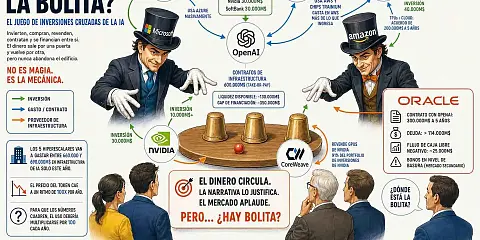
I suppose I'm not the only one who has seen them in action. With their little table, their three cups, and their artist's hands that, in quick circular movements, make it impossible to know where the pea is. The pea whose appearance where you expected it will determine whether you win or lose. A fascinating show to watch, and a dangerous one to bet on. Where sometimes the winner is actually a friend of the hustler, who pretends to find the pea so that the sucker of the moment is encouraged to win as easily as the other did an instant before. Tell me this doesn't powerfully remind you of the investment dynamics we have been living through these past two years in the world of AI.
Microsoft and AI (or was it the cloud?)
Because the structure is astonishingly similar. In rapid circles, Microsoft invests $13 billion in OpenAI, OpenAI spends massively on Azure, so that Azure reports record growth, and the market rewards Microsoft with a higher valuation for leading the AI revolution. Or was it the cloud revolution? It depends a bit on what each person wants to see, but the only sure thing is that the money goes out one door and comes back in through another, but never leaves the building. And it's not the only artist. Amazon does the same with Anthropic: it invests up to $33 billion, and Anthropic spends more on AWS than it brings in. Google, which competes with Anthropic through Gemini, invests $40 billion in it and signs a $200 billion cloud capacity deal with it. You compete with your customer, who is your portfolio company, who is your supplier. The hustler's friend finds the pea, the audience gets excited, and the money circulates without anyone asking whether there really is a pea. Three trusty tricksters threshing trillions in a wheat field, as the old Spanish tongue twister (tres tristes tigres, "three sad tigers") might go if dragged into these times of fuzzy logic and three-dimensional shell-gaming.
Nvidia: the elegant ones keep a low profile.
Nvidia is perhaps the most elegant case. It invests $10 billion in Anthropic and $2 billion in CoreWeave, whose business, to nobody's surprise, consists of reselling Nvidia GPUs. CoreWeave represents 91% of Nvidia's investment portfolio. In other words: the toll collector invests in its own reseller, which pays the toll with money partly financed by the toll collector itself. There's nothing illegal about it, but it's worth understanding the mechanics before applauding the quarterly results.
Oracle: Take it to the limit
And then there's Oracle, which for me is the most unsettling case. It has signed a five-year, $300 billion contract with OpenAI. The market rewarded the news with a 43% jump in a single day. But Oracle's debt exceeds $114 billion, its free cash flow is negative by almost $25 billion, and its bonds trade on the secondary market as if they were junk despite formally keeping an investment-grade rating. Its star customer, OpenAI, has recently missed several internal revenue targets, and its own CFO has expressed doubts about the company's ability to cover its infrastructure commitments if growth doesn't accelerate. Oracle is going into debt to build data centers for a customer that doesn't know whether it will be able to pay for them. If one of my students presented this to me as a case study, I'd ask them to review their premises. And I'd be left wondering whether I was facing a genius or a complete idiot. But since they aren't students, but supposedly solid companies, they will always find someone to laugh at their jokes.
It all started with Sam
But if there is one player who deserves special attention in this game, it's OpenAI. Let's start with its latest funding round: $122 billion at a valuation of $852 billion, closed on March 31, 2026. It sounds impressive until you look at who is putting up the money: Amazon invests $50 billion, Nvidia $30 billion and SoftBank another $30 billion. Once again, three trusty tricksters, wouldn't you know it. Sorry, I meant to say that the three largest investors are simultaneously infrastructure or hardware suppliers to whom OpenAI will return a good chunk of that capital in the form of computing contracts. But there's more: $35 billion of Amazon's investment is conditional on OpenAI going public or achieving artificial general intelligence. In other words, it isn't available capital but a promise tied to two events that haven't happened yet and that nobody knows will ever happen.
The company has racked up $600 billion in contractual infrastructure commitments (contracts it must pay whether or not it uses the capacity) against available liquidity of around $130 billion. The funding gap is $350 billion. Once again, this isn't coincidence, it's pure causality: that is exactly what the IPO is designed to cover. According to the Wall Street Journal, OpenAI missed multiple internal revenue targets in early 2026, something the company hastened to deny. Its CFO has said internally that the company might not be able to meet its commitments if growth doesn't accelerate. And meanwhile, its CEO announces social networks, shopping agents and web browsers. This isn't scattershot whim: it's the desperate need to inflate user metrics to sustain an IPO narrative without which the numbers don't add up. Each new announcement isn't a product, it's a prospectus.
Friends for life
Meanwhile, Anthropic (with annualized revenue already approaching $45 billion and a solid enterprise base) is negotiating a new round that would value it at $900 billion, according to the Financial Times. I suppose the extra billions relative to OpenAI's valuation are there just to cheer up Altman, whose tender relationship with the Amodeis is the talk of the industry. They present themselves to the market as the company that spends less, bills more, and doesn't need to announce social networks to justify its existence.
In the shell game, OpenAI is neither the spectator nor the friend pretending to win. OpenAI is the middle cup: if it turns out the pea was never there, all the other players lose at the same time. Oracle, with $300 billion committed to data centers for OpenAI. CoreWeave, with $22 billion in capex financed with GPU-backed debt. Nvidia, with $30 billion invested directly. And Microsoft itself, whose RPO depends to a large extent on OpenAI delivering on its promises.
When elephants fight, it's the grass that suffers
The five largest hyperscalers are going to spend between $660 and $690 billion on AI infrastructure this year alone. Precisely the GDP of Argentina, and when I looked it up, I couldn't have landed on a country that gives a worse impression of solidity. And while spending skyrockets, the price of the token (the product they manufacture) is falling at a rate of 100x per year. Companies are investing historic sums to manufacture something whose price tends toward zero. For the numbers to add up, usage volume would have to grow a hundredfold every year just to keep revenues flat.
I'm not saying artificial intelligence is a mirage. It generates real value, and some companies in the ecosystem are growing solidly and generating a surprising amount of revenue for their age. But it's one thing for the technology to work and quite another for the financial expectations built on it to have their feet on the ground. And when an entire ecosystem depends on companies that are not yet profitable generating the demand that justifies trillions in infrastructure, it's worth remembering that in the shell game, the pea isn't always where it seems.
And in this case, it isn't even clear there is a pea. Someone should ask TSMC, which owns the casino and is the only one making the tables and the cups, what it thinks of all this.
Our latest news
Interested in learning more about how we are constantly adapting to the new digital frontier?
Corporate news
October 7, 2026
Sngular grew by 7.2 per cent in the first half of 2026


Strategy
September 29, 2026
Would you hand your wallet to Zuckerberg?