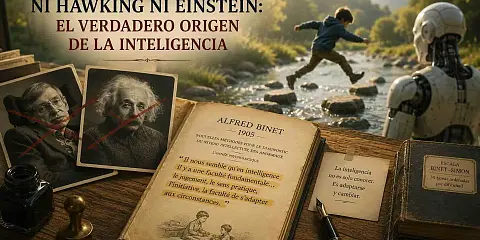
Neither Hawking nor Einstein. The true origin of intelligence

July 21, 2026
Not long ago, while preparing a talk, I wanted to open with a quote about intelligence that carried some weight. So I went looking for a definition I had read years ago and found solid, because it spoke of intelligence as the capacity to adapt to one's environment. But the search results threw me, as tends to happen whenever you scratch a little below the surface. To sum up the process, I was left with two candidates:
"Intelligence is the ability to adapt to change," attributed to Stephen Hawking, and another that seemed to belong to Albert Einstein: "The measure of intelligence is the ability to change."
Both lovely, emphatic, inspiring, consistent with my memory... but far too similar to each other. And, as I feared when reading them side by side, both were fake.
After spending a while digging (and for anyone looking for the truth, we live in a golden age of available tools), I found that there are no primary records confirming that Hawking or Einstein ever uttered these words. But it turned out that, in Hawking's case, the Washington Post had investigated it thoroughly in 2018. It contacted two of his biographers, Kitty Ferguson and Kristine Larsen, and neither could provide a source. Ferguson, who wrote his biography with Hawking's own support, replied: "It sounds like something Stephen might have said, but I never heard him say it, nor have I read it in any of his books." The phrase does not appear on his Wikiquote page, which documents every quote with its primary reference. And the Einstein one fares even worse: according to an exhaustive search of Google Books, it does not appear attributed to him before 2013. Two more examples of how the Internet manufactures the appearance of truth through consensus among mistaken humans... and further proof that, in the end, the poor machines feed on the garbage we put on their plate.
They are what people in the trade call "orphan quotes": phrases that sound so good and come in so handy on a PowerPoint slide that nobody bothers to check whether the author actually said them. The mechanism is well known: someone writes it on the internet, someone else copies it, a third person prints it on a T-shirt, and by the time you want to verify it, it already has a million Google results, all citing one another and none pointing to the original. Because there is no original.
But here comes the interesting part. Because the idea does have a documented origin. Less glamorous than a pair of theoretical physicists whom almost nobody really understands, but of enormous significance for the concept of intelligence we work with today.
An awkward assignment
In 1904, the French Ministry of Public Instruction had a practical and politically delicate problem: it needed a tool to identify children with developmental delays and separate them from ordinary classrooms. Not to punish them, but to offer them an adapted education instead of sending them straight to institutions. The task was entrusted to Alfred Binet, a psychologist with legal training who worked at the experimental psychology laboratory of the Sorbonne, and to Théodore Simon, a young psychiatrist with access to a study population in a hospital.
In 1905 they published "Méthodes nouvelles pour le diagnostic du niveau intellectuel des anormaux" ("New methods for the diagnosis of the intellectual level of abnormals") in "L'Année psychologique". Hold on to that title, because it matters, and we will come back to it. In that article, Binet and Simon defined intelligence with a precision that justifies why, 120 years later, we are still following in their wake:
"Il nous semble qu'en intelligence il y a une faculté fondamentale [...] Cette faculté, c'est le jugement, autrement dit le bon sens, le sens pratique, l'initiative, la faculté de s'adapter aux circonstances."
"It seems to us that in intelligence there is a fundamental faculty [...] This faculty is judgment, otherwise called good sense, practical sense, initiative, the faculty of adapting oneself to circumstances." From that clinical effort came the first practical scale for measuring intelligence: the Binet-Simon scale, with thirty tasks ordered by difficulty, from following an object with the eyes to repeating long sequences of numbers. Francis Galton had done psychometric measurement in the preceding decades, but focused on sensory abilities and reaction times. What Binet introduced was something else: measuring complex cognitive abilities such as judgment, comprehension and reasoning. His scale later evolved along different paths: Terman made it universal at Stanford in 1916 with the Stanford-Binet, and Wechsler developed, in parallel, a structurally different model based on subscales and deviation scoring, which dominates clinical practice today. But the intellectual starting point is the same: intelligence as the capacity to adapt to change.
What the title reveals
We said above that the title of the 1905 article matters. Let's read it again: "Diagnosis of the intellectual level of abnormals." Binet was not trying to measure intelligence in general. He was trying to diagnose its deficit in children who could not keep up with the pace of an ordinary school. It was a clinical tool, designed to identify what was missing, not to quantify what was in surplus. Intelligence as adaptability was not born as a philosophical definition. It was born as a diagnostic criterion for detecting those who could not adapt.
And Binet, by the way, would have been horrified by what was done with his scale after his death in 1911. Lewis Terman, influenced by the eugenics movement, turned it into a tool for social classification. In 1909, in "Les idées modernes sur les enfants", Binet had written something worth remembering: "We must protest and react against this brutal pessimism that claims an individual's intelligence is a fixed quantity, a quantity that cannot be increased." Sadly, the tool he designed to help children with difficulties ended up being used by others to label them.
But what interests me here is not the history of intelligence tests. It is something that went unnoticed for 120 years and that the arrival of artificial intelligence turns into an uncomfortable question.
The missing body
Let's reread Binet's definition: intelligence is the faculty of adapting oneself to circumstances.
Adapting. To circumstances.
The key word is not "adapting." It is "circumstances." For there to be adaptation, there has to be an environment to adapt to. A physical environment, changing, unpredictable, one that pushes on you and to which you respond. A child who cannot adapt to the classroom. A professional who cannot adapt to the market. An organism that cannot adapt to the climate. Binet was not talking about solving abstract problems in an exam. He was talking about what we would now call situated intelligence: the capacity of a body, in a context, to respond to what surrounds it. About what turns a rather uncompetitive primate like man into a being capable of trying to dominate nature and of creating intelligences complementary to its own.
An LLM has no body. It has no environment. It has no circumstances. It adapts to nothing because there is no "outside" to adapt to. It receives a sequence of tokens and generates the next most probable sequence. If the world changes between one query and the next, the model has no idea unless someone writes it into the prompt. It does not perceive, it does not act, it does not suffer the consequences of its answers. It is, in the most literal sense of the 1905 definition, the opposite of intelligent: a system that cannot adapt to circumstances because it inhabits none.
A child learns what heat is by getting burned. And never forgets it. An LLM can be connected to a temperature sensor. But that will not make it feel what happens when a threshold is crossed, much less pull away the sensor that feeds it the information so that it does not get burned.
The line of research connecting intelligence with the body is neither new nor marginal. Francisco Varela and Humberto Maturana developed the concept of embodied cognition ("enaction") in the 1980s. Rodney Brooks, co-founder of iRobot, argued in the nineties that intelligence without a body is not intelligence. Andy Clark, in "Supersizing the Mind", extended cognition beyond the brain, into the body and the environment. None of them cited Binet, but all of them were saying, with greater philosophical sophistication, essentially the same thing: there is no intelligence without a world.
I already explored this from another angle in the previous article, when I argued that an LLM has neither consciousness of what it knows nor conscience about what it produces. The absence of a body adds a third shortcoming: it has no circumstances. And without circumstances, according to the first scientific definition of intelligence on record, no adaptation is possible. Simply because there is nothing to adapt to.
The irony of the benchmark
And here comes what should really give us pause. Today, the race toward artificial general intelligence (the much-coveted AGI) is measured with benchmarks. MMLU, ARC-AGI, GPQA, HumanEval. They all essentially evaluate the same thing: a system's ability to solve problems, show initiative when faced with unfamiliar tasks, and adapt to varied contexts.
In other words: judgment, practical sense, initiative and adaptation to circumstances. Exactly Binet's 1905 definition.
A hundred and twenty years later, we are still measuring intelligence with the same criteria a French psychologist designed to identify children with developmental delays. Except that now the test subjects are systems that have no body, no environment, and adapt to nothing. We ask them to demonstrate adaptation to circumstances in an exam that, by definition, has no circumstances. And when they score well, we conclude that they are intelligent.
Binet, who devoted the end of his life to warning against the simplistic use of intelligence metrics, would probably have something to say about that.
And AI doesn't want you to know
There is one last detail worth noting. When I asked different language models about Binet and Simon's original article, several of them omitted or softened the word "anormaux" in the title. In the medical terminology of 1905, the term was technical, neutral and free of any pejorative charge: it simply designated those who deviated from the statistical norm, nothing more. But the alignment systems that govern what an LLM can say tend to filter out terms that are sensitive today, putting contemporary well-meaning correctness ahead of historical rigor. It is not a deliberate decision by the model, because an LLM deliberates nothing, as I argued last week, but a statistical side effect of reinforcement learning from human feedback (RLHF): if the evaluators penalize uncomfortable terms, the model learns to avoid them, including the ones that are historically accurate.
The result is a system that rewrites history as it tells it. Not out of malice or ideology, but by design. Which, if you think about it, is a rather eloquent example of its limitations: a machine that cannot faithfully reproduce the title of a scientific paper because its training has conditioned it to avoid words that are uncomfortable today but were simply precise back then.
The question that remains
Let's go back to the beginning. The idea that intelligence is the capacity to adapt to change is not Hawking's or Einstein's. It belongs to a French psychologist who formulated it to diagnose a deficit, not to define a virtue. And the definition demands something that today's AI does not have and cannot have as long as it works the way it works: a body in a world to respond to.
Perhaps the question is not whether artificial intelligence is really intelligent. Perhaps the question is whether we even know what we are measuring when we say that it is.
This article is part of a series...
Our latest news
Interested in learning more about how we are constantly adapting to the new digital frontier?

Corporate news
October 7, 2026
Sngular grew by 7.2 per cent in the first half of 2026


Strategy
September 29, 2026
Would you hand your wallet to Zuckerberg?