
Are they making room for us?

June 9, 2026
The technology pyramid
When, thirty years ago, people started talking about the need to align technology management with corporate strategy, I stumbled upon a book that I still use as a reference. It's called "Competing in the Information Age," and it brings together several articles with fairly similar theses on the need for strategic alignment between the two worlds. In chapter 12, Weill and Broadbent discussed the value of technology and the role of investment in technology infrastructure within companies. That chapter had so much substance that it ended up becoming a book of its own. But what I want to recall now is a chart that caught my eye. This one:
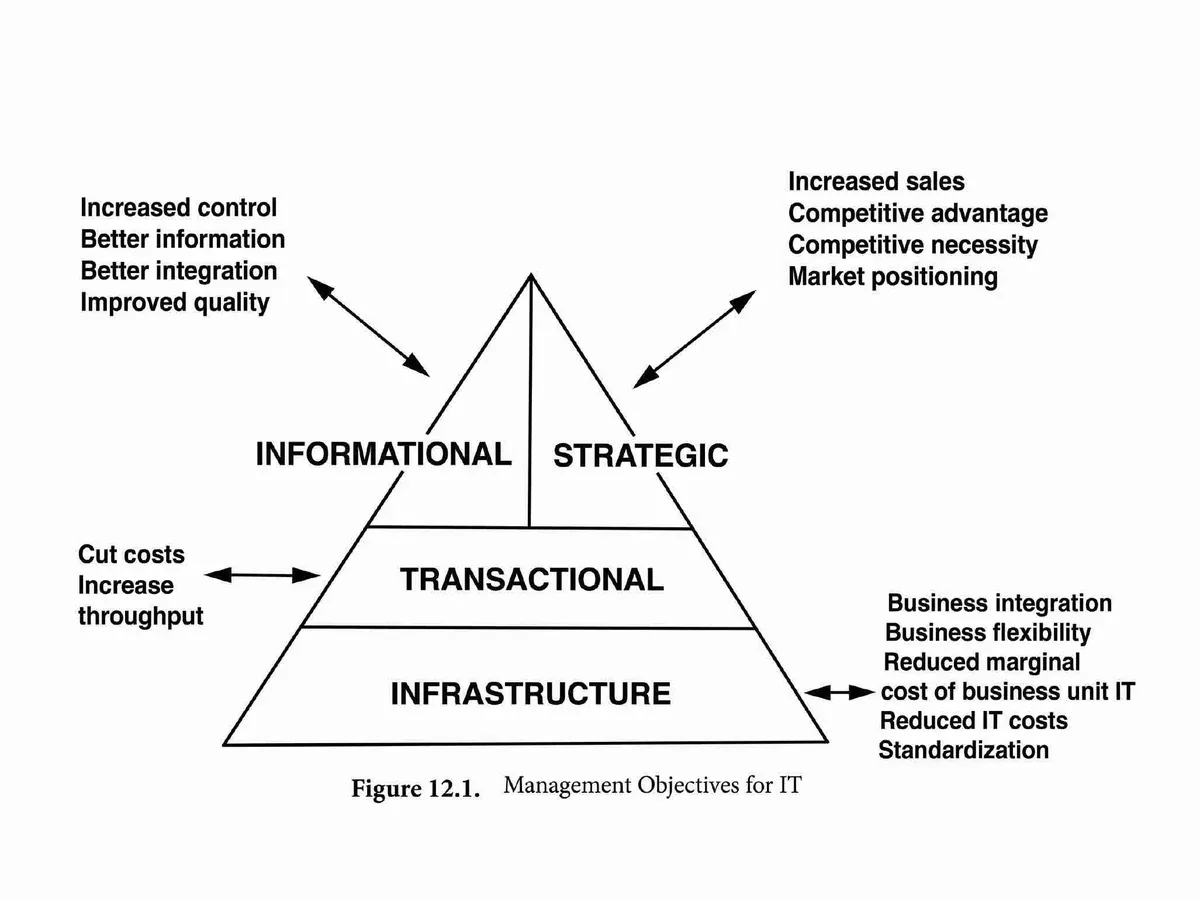
The authors' thesis is that there is an appropriate mix of investment in technology infrastructure for each type of strategy. But I always found it more interesting to use the diagram as a tool to measure the life cycle of technologies. In my view, every relevant technology enters at the top of the pyramid as strategic, because it helps you improve your competitive advantage. But it then slides down as other competitors adopt it, and ends up becoming pure infrastructure.
Think about what happened with ERP: when it first appeared it was a top-tier competitive weapon. Today, if you don't have one, it's because you don't exist.
Change is accelerating
The interesting thing is not that this happens, but the speed at which it happens, and how that speed keeps increasing. ERPs took about twenty years to descend from the strategic apex to the base of the pyramid. Cloud took ten: in the mid-2000s, being in the cloud was a real competitive advantage; today, the debate is whether to repatriate workloads to save costs. And large language models — the LLMs starring in the current AI fever — are making that same journey in three or four years. What in 2023 were ChatGPT-based applications that seemed to work magic is, in 2026, a feature Microsoft throws into Office for twenty dollars a month. Is there anything more trivial than Office in 2026?
Twenty years. Ten. Three. It's like The Mystery of the Great Pyramid: gravity in there accelerates and doesn't forgive a single mistake.
The most staggering thing about all this is that technological acceleration directly compresses economic cycles, which have gone from the 40 to 60 years described by Kondratiev to the much shorter ones we live through today.
Anyone who has followed the articles I've published over the last few weeks will have recognized, perhaps without realizing it, the different symptoms of this same phenomenon. "The end of flat-rate tokens" was a symptom of the fall: when technology slides down the pyramid, marginal costs matter again and the open bar disappears. The "Genesis Mission" was an example of confusing the layers: investing as if the frontier model were the strategic asset, when the real asset — data — lives in another quadrant. "The pea" described the financial mechanics of those trying to hold at the apex a technology that gravity is pulling down. And the "Typewriters" were the historical warning of what happens when a massive investment is made in a paradigm that is about to be replaced by another: the capital cannot be transferred.
All of this has a name in the language of this pyramid. And it isn't pretty. It's called "accelerated fall into infrastructure." But you can call it "devaluation" if that sounds more familiar. And the worrying part isn't that it happens, because it will, but that strategic-quadrant money is being spent on something that already shows every symptom of heading for the basement.
We've seen this before
It's the same mistake the telecom operators made at the beginning of the century; and I know this one well because I lived it from the inside at Terra. The telcos built the highways on which Google, Netflix and Amazon built their empires, without capturing the value of what traveled over them. Just as the telcos did before them, the hyperscalers that condemned them to irrelevance are repeating exactly the same move: they build data centers to transport tokens. Ignoring that the value of whatever is done with those tokens will be captured by whoever controls the application, the data or the next paradigm. Poetic justice, thirty years later.
But the pyramid doesn't only describe falls. It also reveals gaps. Every time a technology slides toward the base, it frees up the space it occupied at the top. And that empty space is, by definition, where the next competitive advantage will be generated. The question isn't who dominates the falling paradigm, because that battle already has an owner, and probably a loser. The question is who is placing pieces at the apex that has just been vacated.
The great opportunity
And this is where the reading becomes interesting for those of us who live on this side of the Atlantic.
Yann LeCun, Turing Award winner and co-founder of deep learning, left Meta in November 2025 after twelve years. And in March 2026 he closed a round of more than a billion dollars for AMI Labs, a Paris-based startup dedicated to building what he calls "world models." An open bet on a paradigm shift: he believes the future belongs to AI systems that learn from the physical world, not from predicting words. Mistral has spent years proving from France that algorithmic efficiency can compete with brute force. ASML, from the Netherlands, makes the machines without which no advanced chip on the planet can be produced. And Taalas, a Canadian startup I wrote about a few months ago, has shown that a model can be cast directly into silicon with a performance and cost that invalidate the logic of the monstrous conventional datacenters. The Chips Act 2.0 currently being debated in Brussels could be the missing piece: steering public investment toward advanced nodes using ASML technology, closing the complete value chain — efficient model, specialized chip, sovereign foundry — on European soil. Indeed: Canada is not (yet) Europe, but it maintains a set of cooperation agreements with the EU in this area that make it a natural technology partner.
But the window won't stay open forever. Nvidia has just unveiled, together with Microsoft, a processor with 128 gigabytes of unified memory and an integrated Blackwell GPU, capable of running on a laptop models that a year ago required a datacenter. If the incumbent also manages to dominate inference at the edge — on top of training in the cloud and datacenter inference via its recent acquisition of Groq — the gap we're talking about will close before anyone gets to sit in it.
What these pieces have in common isn't just that they are good. It's where they sit in the pyramid. They don't compete at the base — in the commodity infrastructure of GPUs and datacenters where the American hyperscalers are burying hundreds of billions. They compete in the upper quadrants: in chip architecture, in model efficiency, in the design of the paradigm that comes next. In other words, exactly where the pyramid says value is created.
One Nvidia to rule them all...
And all of them target the same Achilles' heel: dependence on NVIDIA's architecture, which devours energy at a rate that is already forcing the hyperscalers themselves to ration the quality of their models so as not to collapse their data centers. Taalas proposes eliminating that dependence by casting the model directly into silicon — no GPUs, none of the brutal power consumption that comes with them. If that works at scale, today's datacenters are left without a purpose. But Taalas doesn't need to succeed for the model to crack: it's enough for memory to return to its historical cycles of falling prices, or for architectures like BitNet to keep proving that a competitive model can run on consumer hardware, for the business model based on selling access to extremely expensive GPUs to lose its raison d'être.
And this is where I want to add something that goes beyond the technical.
...and a value system thousands of years old
Europe and Canada share something that doesn't appear in Weill and Broadbent's pyramid but that weighs more every day in the economics of technology: a model of values. Facing a China whose technological deployment is inseparable from social control, and a United States whose predictability as a technology ally has deteriorated markedly in recent years, the Euro-Canadian axis represents something the market has not yet priced in: institutional stability, respect for privacy, and a regulatory framework that — with all its flaws — answers to citizens, not to shareholders or a single party. Balance and reliability, two words that are key when you are betting on a supplier for the long term.
This isn't pro-European rhetoric. It's the best possible foundation for a solid sales pitch. When a company, let alone a state, chooses which infrastructure to build its AI strategy on, it doesn't just evaluate performance and price. It evaluates jurisdiction, regulatory continuity and confidence that the rules won't change from one tweet to the next. And on that terrain, the combination of European and Canadian technology with Western democratic values offers something that neither Silicon Valley nor Shenzhen can guarantee today.
What's remarkable is that this argument holds even if the technical bet doesn't turn out exactly as LeCun predicts. Let's imagine that world models take longer than expected, or that LLMs turn out to be more adaptable than we skeptics think. Even in that scenario, the existence of a sovereign technological alternative, built on stable institutional principles, has strategic value in its own right. Because technological dependence on a single supplier — or a single geopolitical bloc — is a risk that is measured not in benchmarks but in sovereignty.
The gap in the pyramid
Back to the pyramid. What Weill and Broadbent taught us thirty years ago is that infrastructure, on its own, doesn't generate competitive advantage. What generates it is the combination of a well-chosen strategic technology with the organizational capability to exploit it. And what I'm seeing is that while some are spending historic sums at the base of the pyramid — on datacenters, on GPUs, on ever cheaper tokens — others are quietly placing pieces in the quadrants where the pyramid says the real value is captured.
Are they making room for us between the two empires? Maybe. The question is whether anyone in foggy Brussels will have the judgment — and the courage — to put old Europe in it.
This article is part of a series that began with "Less Wood, It's War!", and continues with "The end of the token open bar, or something more serious?", "What if the Genesis Mission were a huge mistake?", "Where's the pea?", "From packet to token, and back to square one", "Investing in typewriters", "Will the "killer app" arrive in time?". To be continued...
Our latest news
Interested in learning more about how we are constantly adapting to the new digital frontier?

Corporate news
October 7, 2026
Sngular grew by 7.2 per cent in the first half of 2026


Strategy
September 29, 2026
Would you hand your wallet to Zuckerberg?