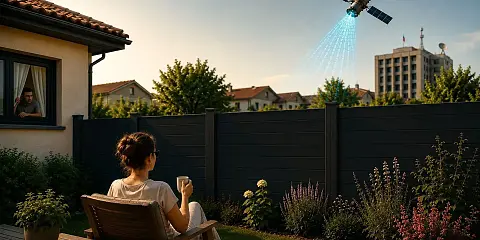
How high is your fence?

August 18, 2026
When I was a child, the holiday developments where the Spanish middle class spent their summers had plots of just over a thousand square meters and, quite often, no fencing worthy of the name. A hedge, a three-foot mesh so the dog wouldn't run off, or one of those low cinder-block walls was enough for most people. You could see the neighbor's pool from your porch, just as the neighbor could see yours. And nobody cared much.
Today those same developments have become denser. Many of the old plots have been split two or three times, giving rise to much smaller spaces. With houses that are sometimes semi-detached but, mind you, almost always surrounded by opaque fences two or three meters high. Concrete panels, dense lattices, reed screens, and a whole defensive deployment in the service of a privacy that, at that distance, is physically impossible. Because you can hear the conversation on the other side, smell their barbecue and suffer their taste in music. But you can't see them. And that, apparently, is enough.
The vertical expression of a horizontal problem
There is an old definition of dancing (attributed online to half a dozen wits, which is usually a sign that it belongs to none of them) according to which dancing is the vertical expression of a horizontal desire. And this August I am coming to the conclusion that the fence around the house follows the same idea, with the sign reversed: it is the vertical expression of a horizontal problem.
When the plot was over a thousand meters, privacy was horizontal and came included in the price of the land. Maybe you could see, but at least you didn't share the air. When the plot is halved, the missing distance has to be manufactured, and it can only be manufactured upward. The height of the fence says less about how jealous the owner is than about the surface area he no longer has. An indicator of scarcity disguised as an aesthetic choice.
Although what strikes me more is what it is meant to protect against. It is no use against the burglar, for whom two meters of reed screen are an invitation and, once he jumps over it, a guarantee of privacy. It doesn't shield you from the Administration and its aerial photogrammetry flights. The fence goes up against the neighbor. Against one's equal. Against the person who lives in the same development, has paid off a similar mortgage and competes for the same parking space. It is a strictly horizontal defense, between peers, that takes vertical form because there is nowhere else to put it.
The wall is also an app
The striking thing is that on the Internet we have done exactly the same, and in the same direction.
Everything we have learned to do to protect ourselves online is horizontal defense. Locked profiles, private accounts, close friends lists, self-destructing messages, blocking, alt accounts for whatever we don't want the boss to see. All that artillery is aimed at the coworker, the brother-in-law, the ex, the annoying acquaintance. At the digital neighbor.
But, just like at the house, there is no fence that works upward. For whoever aggregates, whoever profiles, whoever cross-references our behavior with that of two hundred million other people, we have left the garden open and the kitchen door unlocked. Perhaps because we can't see them. You feel the neighbor's gaze. You don't feel the aggregated gaze. Nobody has ever noticed being profiled. We defend ourselves against what we can see at work, and a fence has the enormous pedagogical advantage that you can see it working every single day.
The one who sells the fence lives inside
Here comes the paradox, which also happens at the house: the fencing usually comes included in the developer's list of specifications. In other words, whoever sells you the small plot also charges you for the remedy that keeps it from looking small. He charges twice: for the problem and for the consolation. The high wall is, in fact, what makes the tiny lot sellable.
But if, as the old Spanish comedy gag has it, "es triste de pidil, más triste es de robal" (begging is sad, stealing is sadder), then in the digital world the overlap between the fence seller and the beneficiary of the open field is even more brazen.
Street View blurs faces and license plates with remarkable diligence. It protects you from the curious passerby while it photographs your entire street, indexes it and keeps it. The fence against the horizontal gaze is installed, free of charge, by the one who passes right over it.
In 2021 Apple launched its App Tracking Transparency, that dialog that lets you deny each app permission to track you. An excellent button, technically impeccable, that shuts the door on third-party advertisers. A coincidence that it appeared just as Apple itself was building its advertising business? Or simply that the fence was being sold by someone who lives inside the compound.
WhatsApp encrypts content end to end, yes. Very thoughtful of them. But what isn't encrypted is the metadata: who talks to whom, when, how often, from where, for how long. For almost any analytical purpose, that is worth more than the content. It is an opaque three-meter fence with the mailbox wide open at the gate.
And Google has done all kinds of somersaults since it announced six years ago that it would eliminate third-party cookies from Chrome and replace them with its Privacy Sandbox. Half the advertising industry reorganized itself around that promise. In October 2025 it withdrew most of the APIs that were supposed to replace cookies. Third-party cookies are still there. What was announced as the industry's great enclosure ended up being a fence that was never built, while first-party data (its own, as it happens) remained untouched throughout the whole operation.
In all four cases the fence is real and it works. Against the neighbor. There is no deception, which is what makes the matter interesting: there is redirection. They sell us protection against the gaze we can feel and, in passing, inoculate us against missing the one that counts. The fence doesn't hide the data. It hides the fact that we don't have any.
There's a "La Moraleja" in digital too
Still, the development of small plots is not the whole map. There are still places where thousands of square meters are sold and where nobody needs reed screens, because the distance from the neighbor is still provided by the land. La Moraleja, Madrid's most exclusive residential enclave, has not disappeared: it has become more expensive and more exceptional. The country estates of Castile need no fencing because they have hectares at the disposal of the family that enjoys them in peace. And exactly the same thing happens in digital.
Since 2023, Meta has been offering a paid subscription in Europe so you don't see personalized ads. It is the explicit sale of square meters: whoever can afford it buys distance. The European Commission found that this binary model breached the Digital Markets Act, fined the company 200 million euros in April 2025 and forced a third option (with less personalized ads, and free) that has been rolling out across Europe throughout 2026. Translation: the regulator ruled that you can't build a development in which the only plot with trees is the paid one. It is probably the first ordinance in history to regulate the height of the other wall.
The same tiering is everywhere. The cheap Netflix or Prime Video plan with ads and the expensive one without. The free email that gets read to segment you and the paid one that promises not to. And, above all, the enterprise version of almost any artificial intelligence service, where the clause stating that your data will not be used to train the model costs a very specific amount of money per user per month. Since my company sells these things, said with all the transparency the matter demands, I know what those square meters are worth.
But this is where the parallel breaks down, and in the worst direction. The three-thousand-meter plot in La Moraleja is yours, it is in the Land Registry, and its privacy is guaranteed by physics and by stable law: the distance exists even if the developer goes bust. The large digital plot is not a plot. It is a clause. Its opacity is not upheld by the land but by a contract the other party can revise with thirty days' notice, a privacy policy change you will accept without reading, or a court order... not to mention the basic regulations that its home country imposes on whoever provides the service. You pay for a wall and receive a promise not to look. Which is kept, most likely. But it is kept because whoever signed it decides to keep keeping it, or because nobody forces them to break it.
And there is a lower rung that doesn't exist in the brick-and-mortar development. Whoever can't afford the large plot, in Boadilla or in Torrelodones, has a small one: fewer meters, same legal status. In digital, whoever doesn't pay doesn't have a worse plot. They have no plot at all. They occupy land that belongs to someone else, and whose exploitation is, precisely, the business model. The difference between the two sides of this development is not one of surface area. It is one of property regime.
The missing tape measure
The maximum height of fencing on a residential plot is regulated by municipal ordinance. In many cases it ranges between one and two meters for the opaque part, with variations depending on the municipality. And the argument over whether the neighbor has gone twenty centimeters over has filled more homeowners' association meetings than any other issue. It was easy to legislate because it can be measured with a tape measure and because anyone understands what is being discussed.
Our European GDPR, which is a serious piece of legislation and has done more for our rights than its bad press suggests, mainly regulates the form of consent: how it is requested, how people are informed, how it is withdrawn. It doesn't regulate the height of the other wall. Among other reasons, because nobody has yet built the tape measure to measure it with.
So there we are, each of us on our four-hundred-meter plot, warily measuring whether the guy next door has raised his reed screen another hand's breadth. We have blocked the neighbor's view of our pool. We have handed the deed to the one who sold us the fence.
And you, who know perfectly well how tall the one around your house is, have another one that is considerably taller and considerably worse built. You have never measured it because nobody has told you where it is. I'll give you a hint: it doesn't face the neighbor's garden.
Our latest news
Interested in learning more about how we are constantly adapting to the new digital frontier?

Corporate news
October 7, 2026
Sngular grew by 7.2 per cent in the first half of 2026


Strategy
September 29, 2026
Would you hand your wallet to Zuckerberg?