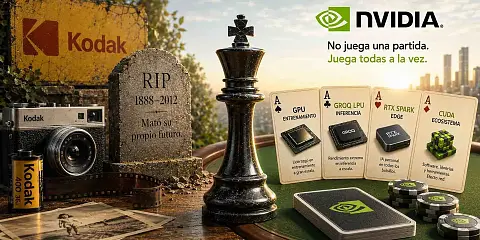
Will Nvidia be the new Kodak?

June 30, 2026
The real problem is coming second
When I was CEO of Terra Spain, I never worried too much about what the ones behind us were doing. Not out of arrogance, but out of arithmetic: when you're first, you set the pace and everyone else has to react. The problem with being second or third isn't just that you're behind; it's that every announcement from the leader forces you into decisions the leader never has to make: is this a real lead or a decoy? Do I follow that trail or crash into it? I remember having fun deliberately launching announcements into the market that were nothing more than decoys, knowing that my competitors would spend weeks trying to decipher them. One of them was even hailed by an international analyst as a new strategic direction, when for us it was the wrong road altogether. But the anecdote matters less than its corollary, which is worth keeping in mind to understand what follows: the leader doesn't need to be right every time; it's enough that the others don't know when it's bluffing. That alone is enough to make life miserable for the competition.
I think about this every time Jensen Huang, the most closely followed speaker since Steve Jobs died, takes the stage. Because in recent weeks he has made two announcements that, taken together, amount to the most ambitious competitive maneuver I can remember in the tech sector. And none of his competitors can tell today whether they are a real lead, a decoy, both at once, or neither.
To understand what's at stake, we need to go back half a century.
The camera Kodak invented and hid
For decades, taking a photograph meant buying a roll of film, shooting blind and taking the roll in to be developed. The developing business was enormous and seemed indestructible, because it was coupled to the habit of taking pictures. Until it wasn't. The digital camera didn't kill photos. It killed developing as a mandatory step. And the interesting part isn't that Kodak went bankrupt, but that it did so in a world where people were taking a thousand times more photos than before digitization. Kodak, Fujifilm and many others were left with factories of chemical paper that were good for nothing. Much the same story Apple would repeat with the iPod against the Walkman: once it realized customers weren't buying cassettes but music on the move, all it had to do was offer more music and more movement to take over, in just a few years, a market Sony considered its own.
But back to Kodak, which few people remember invented the digital camera. In 1975, an engineer named Steve Sasson built the first prototype. Kodak patented the technology but decided not to bring it to market because it cannibalized its film business. In 1989, Sasson came back with a working DSLR, and his marketing department blocked it again. A business with spectacular margins that employed tens of thousands of people could not afford to question itself. From inside Kodak, the decision made all the sense in the world. And it was the worst strategic decision in the history of the technology industry.
Well: Nvidia has just been handed exactly the same dilemma.
Inference decouples from training
If you've been following this series, you'll remember that we've been arguing something that is becoming hard to dispute: language models are being commoditized at a frightening speed, and the inference market (the one that aims to monetize the use of an already trained model) is splitting off from the training market like an iceberg breaking in two.
On one side, startups like Taalas are showing that you can cast a model directly into silicon, multiplying per-user performance by more than seventy times compared with an Nvidia GPU at a tenth of the energy consumption. Before some "member of the strict observance" banishes me, let me clarify that this happens under single-user conditions, not under concurrency, and with aggressive quantization that degrades model quality. But it opens a path. On the other side, Microsoft has released BitNet, a framework that lets you run two-billion-parameter models on an ordinary CPU. No GPU, no cloud, no monthly bill. Granted, the hundred-billion-parameter model doing the rounds in the headlines is, as of today, theoretical: nobody has trained or released it. These are different technical paths, hardware and software, but they point to the same goal: inference doesn't need the same machines as training. And if inference is the bulk of the business going forward, the general-purpose GPU stops being indispensable for it.
Nvidia knows this. And what it has done about it is highly revealing.
Twenty billion so as not to put the camera in the drawer
On Christmas Eve 2025, Nvidia closed the largest acquisition in its history: twenty billion dollars for the assets and technology of Groq, a startup that made SRAM-based inference chips capable of processing language at speeds GPUs couldn't match. Three months later, at the GTC 2026 conference, Jensen Huang unveiled the Groq 3 LPU: Nvidia's first non-GPU chip, integrated into its Vera Rubin platform as a coprocessor dedicated to inference. According to his figures, the LPX rack combined with Vera Rubin delivers thirty-five times more throughput per megawatt than its own Blackwell NVL72 for one-trillion-parameter models.
You have to give Jensen credit for not repeating the mistake of Kodak's management. He didn't put the digital camera in the drawer. He spent twenty billion buying someone else's digital camera. And he showed it to the world in record time.
But that was only the first move that, from within Nvidia itself, called into question the fundamental assumptions of the business model that has made it the most valuable company in the world. The second came at Computex 2026, just a few weeks later.
A camera in every pocket
Together with Microsoft, Nvidia unveiled RTX Spark: a superchip that integrates a twenty-core ARM Grace CPU, a Blackwell GPU with 6,144 CUDA cores, and up to one hundred twenty-eight gigabytes of LPDDR5X unified memory. Not for a datacenter, but for a laptop! The Surface Laptop Ultra, equipped with this chip, can run models of up to one hundred twenty billion parameters locally, according to Nvidia. Eighteen months ago, that required a rack of servers in a refrigerated datacenter.
It escapes no one that the architecture (a complete system on a chip, ARM architecture, unified memory, CPU and GPU packaged together) is exactly what Apple has been doing since it launched the M1 in 2020. And that, since then, MacBooks have become the default machine of the developer community. What Jensen has done is copy Apple's architectural formula, but build into it his CUDA ecosystem and his entire AI stack. The result: a thousand TOPS of AI compute versus the thirty-eight of Apple's Neural Engine. Twenty-five times more local inference capacity in a laptop with the same design concept.
Jensen's move isn't merely defensive. It's a triple-hedge strategy that reveals what he thinks about the future of his own market. If inference stays in the cloud, he has Groq for the datacenters. If inference moves to the edge (whether to the laptop, the local device, or the server of a company that doesn't want to depend on third-party APIs), he has RTX Spark to colonize that ground. And along the way, he challenges Apple for the developer base, which is, in the end, who decides which platform wins.
In other words: Nvidia hasn't just taken the digital camera out of the drawer. It has put it in every pocket. And that is what makes the maneuver so hard for its competitors to read. Is the Groq LPU the real future and RTX Spark the decoy? Or is it the other way around? Or are both viable at the same time, with Jensen covering every exit so that no one else can take them? AMD and Intel have to decide whether to respond in the datacenter or at the edge. Apple has to decide whether to respond on AI capacity or defend its developer ecosystem. And none of them can afford to respond on every front at once. That's the first mover's advantage: you don't need all your bets to win. It's enough that your rivals don't know which one is the real one.
The monopolist's reflex
There is also a qualitative difference between what Kodak did and what Nvidia is doing. Kodak let its competitor die (which, ironically, was itself). Nvidia has decided to buy the competitor so that nobody else can use it. It's not the same strategy. From the market's point of view, it's worse.
Senators Warren and Blumenthal have already formally questioned whether the deal violates antitrust law. Their argument is simple: Nvidia controls more than eighty percent of the AI training chip market in the US, according to Jon Peddie Research. And now it is absorbing one of the few emerging competitors in inference. With RTX Spark, moreover, it is positioning itself to dominate local inference. If control of training, datacenter inference and edge inference is consolidated in the same hands, the fragmentation that should open up opportunities for new players is blocked by design. Meanwhile, China keeps "inventing things" on the other side of the Pacific. Quite a dilemma for American lawmakers: deciding whether to back the home team or the supposed principles of their economic system.
The question for those of us following this series is whether regulation will end up forcing precisely what Nvidia wants to avoid: an open, competitive and fragmented inference market. Because if that happens, the pieces we've been describing in previous articles (Mistral, AMI Labs, ASML, Taalas, the Chips Act 2.0) take on a prominence they don't have today.
Be SanDisk, not Kodak
When digital photography killed developing, it didn't kill the whole value chain. It killed whoever processed silver. But those who made the new media (memory cards, sensors, digital storage) built a gigantic business on the ashes of the old one. SanDisk didn't exist in the world of film rolls. Nobody needed it to. Its opportunity was born exactly when the old paradigm collapsed.
If inference fragments, if it stops being an oligopoly of three American hyperscalers and becomes a market where specialized ASICs, efficient models and sovereign hardware compete, the industrial barriers to entry come down. And when industrial barriers come down, talent is what wins.
That's where Europe has something to say. Not because we're going to build the next GPU, but because maybe we won't need to. Maybe what's needed is to design the chip that replaces it, train the model that makes it unnecessary, build the foundry that produces it under our own jurisdiction, or do all three at once. Exactly what LeCun is attempting from Paris with AMI Labs, what Mistral is demonstrating from France, what ASML makes possible from the Netherlands, and what, with any luck, someone in foggy Brussels will champion once they finally wake up and smell the coffee.
The question isn't whether Nvidia will be the new Kodak. Probably not: Jensen is too smart and has too much cash to let himself die. The question is whether, while Nvidia spends twenty billion buying competitors and puts Blackwell in every laptop to close off every exit, someone on this side of the Atlantic will have the vision to occupy the space that is opening up.
Kodak didn't need a competitor to defeat it. It needed a market that would leave it behind. And SanDisk didn't need to defeat anyone. It just needed to be in the right place when the world changed.
This article is part of a series that began with "Less Wood, It's War!", and continues with "The end of the token open bar, or something more serious?", "What if the Genesis Mission were a huge mistake?", "Where's the pea?", "From packet to token, and back to square one", "Investing in typewriters", "Will the "killer app" arrive in time?", "Are they making room for us?" and "Will AI end up in a backpack?". To be continued...
Our latest news
Interested in learning more about how we are constantly adapting to the new digital frontier?

Corporate news
October 7, 2026
Sngular grew by 7.2 per cent in the first half of 2026


Strategy
September 29, 2026
Would you hand your wallet to Zuckerberg?