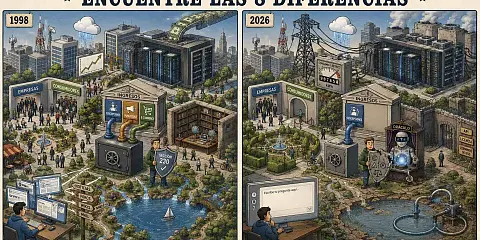
Spot the 8 differences

June 16, 2026
If you're not a digital native, and your childhood didn't begin in a world where glass surfaces reacted when you touched them, the word "pastime" was surely part of your life. Because, astonishing as it may seem, it comes from a galaxy where we had so much time that we looked for ways to fill it before boredom caught up with us. Something astonishing in this era of infinite scrolling, when teenagers fall asleep at five in the morning watching riveting videos of hamburger-eating contests. We, to fill a time that screens had not yet colonized, had rebus puzzles to learn how to think, crosswords to improve our vocabulary, and "spot the n differences" games to sharpen our eyesight. Which is why we don't understand what Instagram and TikTok supposedly bring to our lives.
Many of those games needed no more equipment than a piece of paper and a pen. And in spot-the-difference, the thing was as simple as finding, between two apparently identical drawings, the little things that set one apart from the other. Between two landscapes that looked like the same one, you were happy to discover that in one there's a tree missing, a cat without a tail, or a window that has changed color. And I can vouch that, sometimes, it wasn't all that obvious.
Something similar happens to us today with artificial intelligence and the Internet. Every time someone analyzes the current moment of AI, the comparison with the arrival of the Internet shows up in the first or second paragraph. With some justification, because both are general-purpose technological disruptions, both unleashed an unprecedented investment frenzy, and both promise (or promised) to transform the way we work, consume, relate to one another... or kill our free time. The two drawings look very much alike. But the differences aren't in a cat's tail. They're structural. And anyone who fails to spot them in time is going to make strategic decisions based on a map that doesn't match the territory they think they're standing on.
For weeks now, in this series, I've been picking apart the symptoms of what I consider a historic mismatch between investment in artificial intelligence and the return that can be expected from it. And today, before continuing to look ahead, I want to take a step back and run my pen over the differences I find between two pictures that have been part of my professional life. Because I believe that simplifying the picture by telling ourselves that "this is just like the Internet" can put us in a dangerous position.
So, without further ado, here are the eight differences I've been able to find between those two pictures. But perhaps you'll be able to see one that I've missed. My eyes aren't what they used to be.
The electricity bill
The networks we needed to build the Internet were very expensive to deploy. That's why, before deciding that betting on fiber optics was worthwhile, we first tried reusing telephone networks in various ways. But investing in adapting those networks had one big attraction: once installed, their operating cost was almost negligible. That asymmetry between high investment and cheap operation has allowed decades of falling consumer prices while performance multiplied. With AI, deployment is terrifyingly expensive, but so is operation. Every query to a frontier model burns electricity, silicon and cooling. Anyone who has read the previous articles in this series will have understood why "flat-rate tokens" are disappearing, and will have stumbled upon the "trilemma" between training cost, inference cost and quality of service that we will explore in detail very soon.
Two sides of the coin
The Internet had two sides. The business side, where it was seen as both an obligation and an opportunity regardless of company size. And the personal side, where it was fun, useful and addictive. Generative AI is not achieving that dual traction. Small and medium-sized businesses don't see it as indispensable, and individuals don't find it fun enough or useful enough to reach into their pockets and pay more than a month of Netflix costs them. Without end-consumer traction, the engine that powered the Internet from the bottom up (advertising, virality, network effects) starts with far less force. And without adoption by SMEs, the potential of the corporate market narrows drastically.
The payback problem
The Internet had at least three clear ways to pay for itself: access fees, advertising and e-commerce. Three real revenue streams that still coexist and feed one another. AI, at best, has subscriptions. Advertising inside a conversational model is a zero-sum game, when not downright counterproductive. Because nobody wants their smart assistant slipping an ad in between two answers.
The oracle that guesses
Traditional computing and the Internet are deterministic: if you click on a link, you get exactly that piece of data. Language models are probabilistic. They don't know; they guess the next word with astonishing accuracy, but they guess. That means they hallucinate, they get things wrong unpredictably, and they will keep doing so as long as the underlying technical paradigm doesn't change. To generate a kitten video or summarize an email thread, ninety-five percent accuracy is enough. To automate a critical process in a real company, a system that gets it wrong five percent of the time, with every appearance of total self-confidence, demands layers of human oversight that eat up the return on investment.
The garden and the square
This is, for me, the most profound difference and the least discussed. The Internet exploded because it was built on open, free protocols. TCP/IP, HTTP and HTML. It was conceived by researchers eager to share their findings for the benefit of humanity, who were looking precisely for a better and more universal way to share them. Nobody owned the underlying infrastructure. As a result, anyone could set up a mail server on top of it, or an entire business, without asking permission, without paying a toll, without depending on the goodwill of a third party. In fact, that was the world I lived in professionally during the Internet explosion, and I can vouch that that openness made it possible for thousands of companies, mine included, to exist. If you set up your own mail server today, the private standards imposed by the email oligopolists won't let you connect with "their" users, and you'll have to resign yourself to using an email service where they can listen in on your conversations in exchange for loading your screen with ads.
Today's generative AI is the exact opposite of a selfless effort in pursuit of the common good. It's built on closed black boxes, controlled and funded by a handful of hyperscalers who love building walled gardens, as they already did not only with email but with the dream of Web 2.0. If you build your business model today on the OpenAI or Google API, your margin, your privacy and your survival depend on their pricing decisions and their policies. This is no exaggeration: it's the literal description of a dependency relationship that any executive should assess before signing. And probably the prelude to further differences between the few who can afford to pay to safeguard their (relative) privacy and a majority who will have to resign themselves to three months of faucet ads because they once told their wife, within earshot of their phones, that the kitchen one was broken.
The shield that doesn't exist
The commercial explosion of Web 2.0 (social networks, forums, YouTube) was made possible in large part by "safe harbor" legislation. Such as Section 230 in the United States, or the E-Commerce Directive in Europe. We platforms were not liable for the content our users uploaded. That legal shield was a brutal accelerator of innovation, because it removed a risk that would otherwise have paralyzed any investment.
Generative AI doesn't have that shield. Not only have the models been trained by absorbing the entire Internet with a more than questionable attitude toward copyright, but it is they, and not a human user, who generate the content. The civil liability and intellectual property risk for a company that integrates AI into its processes is an uncleared minefield, and one that we Internet pioneers never had to cross. When the European regulator (and the American one, which is already on it) finish defining the rules, more than one company is going to discover it has a serious problem.
Blank canvas syndrome
Mass adoption of the Internet was achieved by reducing friction to zero. The web browser and the mouse. Point and click. You didn't have to learn anything to start exploring a new world, and the result was usually surprising: a window onto the unknown that was hooking in its own right.
The main interface of generative AI is an empty text box. A prompt. To be useful, it requires the user to know what they want, how to contextualize it and how to ask for it. The cognitive effort required to "talk to the machine" is incomparably greater than scrolling or pressing a button. And the result, let's admit it, is rarely as sparkling or surprising as exploring a website that opened a window onto a world waiting to be discovered. It's an efficient assistant, not an adventure.
The well that runs dry
In the early years of the Internet, a spirit of camaraderie prevailed: sharing everything, for free, for the sheer love of it. Content was driven first by researchers and then by users who had no intention of getting rich from it, because the global project was born under the idea of "let's share knowledge." That generosity created an immense corpus of quality data that fed everything that came after.
Generative AI is driven by huge companies that want to become even bigger. The era of sharing is over: the main content platforms are already signing exclusive access deals, and the data used to train the models is increasingly expensive, of more questionable quality, and no longer universally shared. Models are starting to feed on their own output (AI-generated data to train more AI) in a chain of linked 95% hypotheses that is not exactly a recipe for improving quality. Anyone who has read "What if the Genesis Mission were a huge mistake?" will recognize here another facet of the same problem.
Are we really being fooled and heading for catastrophe?
Does all this mean that AI is headed for disaster, or leading us into one? I don't think so. The idea of a tool capable of generating, reasoning and assisting has dazzled all of us. Most particularly those of us who make a living from technology development, which is where these inventions shine brightest. But I do believe that anyone making investment, strategy or career decisions on the assumption that "this is just like the Internet" has at least eight ways to get it wrong. And in an environment where hundreds of billions of dollars are being deployed on the strength of that analogy, getting eight things wrong at once can turn out to be rather expensive.
The two drawings look very much alike. But the differences are there. Finding them in time is what separates an informed decision from a blind bet. And I'm sure that you, having made it this far, have some difference in mind that I wasn't able to see.
Shall we share it?
This article is part of a series that began with "Less Wood, It's War!", and continues with "The end of the token open bar, or something more serious?", "What if the Genesis Mission were a huge mistake?", "Where's the pea?", "From packet to token, and back to square one", "Investing in typewriters", "Will the "killer app" arrive in time?" and "Are they making room for us?". To be continued...
Our latest news
Interested in learning more about how we are constantly adapting to the new digital frontier?
Corporate news
October 7, 2026
Sngular grew by 7.2 per cent in the first half of 2026

Strategy
September 29, 2026
Would you hand your wallet to Zuckerberg?