Will the new Encyclopedia be European?
September 8, 2026
I confess that until recently I took it for granted that the encyclopedic tradition was a European invention. A child, like all of you, of our navel-gazing Western worldview, I assumed that organizing the world's knowledge had been the idea of Isidore of Seville or, with luck, of Diderot. But it turns out it wasn't. Every civilization that has reached a critical mass of knowledge has felt the need to compile it, organize it and (here is the key) decide by what criteria it is filtered, what we should remember and what we had better forget. You know how it goes, dear reader: history is written by the victors.
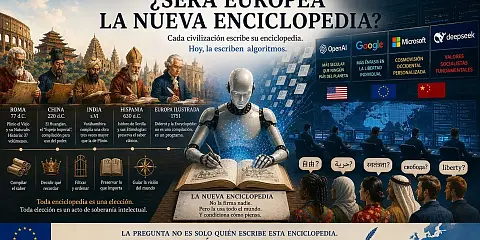
Pliny the Elder did it in Rome in the year 77: thirty-seven volumes of Naturalis Historia cataloging everything from astronomy to mineralogy, with undisguised imperial ambition. In China, around 220, Emperor Wen of Wei commissioned the Huanglan (the "Imperial Mirror"), a systematic compilation of knowledge for the use of power. Twelve centuries later, the Yongle Emperor took the idea to the extreme with an encyclopedia of 22,937 handwritten scrolls and 370 million characters: six times the size of the Encyclopaedia Britannica, and the largest compilation of knowledge in the world for six centuries until it was surpassed by Wikipedia in 2007. In India, Varāhamihira compiled a work of considerable dimensions in the sixth century.
And in Visigothic Hispania, an archbishop of Seville named Isidore wrote the Etymologies around the year 630: twenty books that preserved for medieval Europe the classical knowledge that the invasions were wiping off the map. We now know it was not the world's first encyclopedia, but it is not only ours, it is also the most influential of the Early Middle Ages, and the one that kept alive the thread of Greco-Latin knowledge later tended by Arab scholars.
Our second great milestone as Europeans was Diderot's, eleven hundred years later. And what he did was qualitatively different from everything before. Because the Encyclopédie was not a compilation but a program. Seventeen volumes of text and eleven of plates in which more than a hundred contributors (Voltaire, Rousseau, D'Alembert and Montesquieu among them) organized the knowledge of their time with an agenda they didn't bother to hide: they sought to replace faith with reason, ecclesiastical authority with empirical evidence, and the inherited order with one built on science.
Diderot's stroke of genius was not just the articles. It was the renvois: the cross-references. The hyperlinks of their day which, as people used to say at the dawn of the Internet, could take you from the Vatican to the Church of Satan in California in two mouse clicks. In this way, a perfectly orthodox article on a religious holiday would end up referring the reader to the entries for "Superstition" or "Fanaticism." Worldview engineering lying in ambush inside a navigation system. Everybody understood it. So did the censors who persecuted it, precisely for that reason. And even so, or perhaps thanks to the allure that forbidden things have always had, it transformed Europe.
The pattern repeats itself for two millennia: every civilization writes its own encyclopedia. Rome, China, India, Christian Europe, Enlightenment Europe. Each one decides what counts as knowledge and what doesn't, what deserves to be preserved and what is best forgotten. And each of those decisions is, above all, an act of intellectual sovereignty.
Until now.
The encyclopedia nobody signed
Today someone is writing the new encyclopedias. Only this time nobody signs them, nobody declares the agenda, and their reach makes Diderot's roughly four thousand original subscribers look like a coffeehouse gathering.
The Economist has just published a study in which it put twenty-five frontier artificial intelligence models through the World Values Survey, the survey that since 1981 has measured values and beliefs in more than a hundred countries along two axes: from traditional to secular, and from survival to self-expression. And the results should worry anyone who uses these tools without asking questions.
OpenAI's GPT models turned out to be more secular than any country on the planet, the Nordic ones included. Google's Gemini models give more weight to individual freedom than any real society. No model reflects the worldview of the African or Muslim world. These are not marginal biases. They are extreme worldviews that represent no existing society: the ideological distillate of the teams that calibrate these models in San Francisco (young, urban, secular, progressive, from the US West Coast) turned into a value proposition for the entire world for the next generation. It's not conspiracy-mongering; it's demographics turned into code.
The Chinese models, for their part, operate under an explicit mandate to uphold "core socialist values." If you ask them about Tibet, Taiwan or Tiananmen, they repeat the party line or refuse to answer. But because they are open source, at least they allow their process to be inspected. Researchers who have accessed DeepSeek's internal monologue when it is asked about the Tiananmen protests find the AI itself warning itself about what it must not say. The censorship is visible, which is a good deal more than can be said for the Western alternative.
But the most disturbing finding is not in the answers but in the languages. A team at the University of Oregon showed that when the same politically sensitive question is asked in different languages, the models respond differently depending on the corpus they were trained on in each language. In the languages of countries with low press freedom, the answers lean more toward the regime, even in Western models. An OpenAI model, speaking Chinese, absorbs Chinese censorship from the corpus it learned the language from. Nobody decided this. Nobody controls it. But it happens.
Isidore chose every classical source he preserved. Diderot placed every renvoi on purpose. Here, biases seep in by capillary action, and not even the model's creators know exactly what they are. Total chaos, and it will only get worse as AI feeds back on itself with training data that partly comes from other AIs.
A million readers a minute
And what are the effects of all this? Ones that are no longer theoretical. Researchers at the University of Washington showed that American Democrats who interacted with models calibrated with a Republican bias adopted Republican positions with significant frequency. And vice versa. The effect was more pronounced when users didn't know the bias existed... which is the norm for anyone who opens ChatGPT, Claude or Gemini to look anything up.
Microsoft estimates that nearly one billion people — 18% of the world's working-age population — used generative AI tools in the first quarter of 2026. Not just for work. To get informed, make decisions, ask for advice on how to raise their children or handle a conflict at work. Every answer comes filtered through a worldview that nobody has chosen, nobody has audited and nobody has declared. And as I documented in "Neither conscience nor consciousness", the system can't even tell whether what it says is true. So now, a double somersault: it turns out its answers come with an ideological payload as standard.
To put it in perspective: Diderot needed more than twenty years and twenty-eight volumes to transform the culture of a continent. An AI model reaches more people in a month than the Encyclopédie did in an entire century. And it does so unsigned. With a whole model of life and a value proposition for which nobody takes responsibility.
When even the Vatican is in a hurry
On May 15, 2026, Leo XIV signed Magnifica Humanitas, his first encyclical. More than a hundred pages devoted to safeguarding the human person in the age of artificial intelligence. It is neither a technical treatise nor a condemnation of technology by a Pope who, before becoming one, was a mathematician and understands the phenomenon perfectly. It is the response of the Church's Social Doctrine to the greatest paradigm shift since the industrial revolution. And as is usually the case with Church matters, there are few coincidences: Leo XIV signed it on the exact 135th anniversary of Rerum Novarum, the encyclical with which Leo XIII responded in 1891 to the labor question.
What strikes me is not so much the doctrinal content as the speed. Leo XIII needed thirteen years to articulate an institutional response to the impact of industrialization. Leo XIV has needed only three since the launch of ChatGPT. When the most unhurried institution in the Western world reacts like this, it's a sign that something serious is going on.
The encyclical says something that deserves to be read regardless of one's religious convictions: that artificial intelligence cannot be considered morally neutral. Training a model, choosing data, calibrating values — every decision expresses a vision of the human being. The Vatican says it, but any honest alignment engineer could sign it. Isidore organized knowledge from the standpoint of faith. Diderot, against it. Both signed their work. Those who today design the worldviews that a billion of us consume every day do not.
The sovereignty missing from the debate
And this is where all of this lands in the conversation we have been having throughout this series.
Europe invented the Enlightenment. It invented Social Doctrine. It has the AI Act, the GDPR and a framework of values that — for all its rough seams — is accountable to citizens. In previous articles I have talked about the European technology pieces: ASML, Mistral, AMI Labs, the possible Euro-Canadian axis of Taalas. But that whole conversation about technological sovereignty falls short if it doesn't include what we have put on the table today.
Because you can manufacture your own chips. You can train your own models. You can regulate the use of data. But if the knowledge infrastructure used by your citizens, your companies and your governments comes with a prepackaged worldview that nobody audits or governs, technological sovereignty is an empty shell. It's like owning your own printing press but printing only books written in another language.
The debate in Brussels is about chips, data, industrial competitiveness. One dimension is missing that nobody is articulating with the seriousness it deserves: the cultural one. With what values are the answers that a hundred million Europeans receive every day being filtered? Who decides what is "appropriate" for a model to say about immigration, fiscal policy, the war in Ukraine, the role of religion in public life? And why are those decisions made by teams in San Francisco and Beijing, and not in Berlin, Paris or Madrid?
History supplies the final irony. China, which compiled the world's largest encyclopedia six centuries ago, now writes AI models that export its censored worldview to the planet. Europe, which invented the Enlightenment and gave intellectual shape to modernity, imports worldviews packaged by others and debates whether or not to regulate their consumption.
Every civilization has always written its own encyclopedias. Rome did. China did. An archbishop of Seville did. A French philosopher did. It is the longest and most consistent tradition in the history of knowledge.
Will we be the first generation to give up on writing our own? Can you think of a more alarming symptom of decline than that surrender?
This article is part of a series that began with "Less Wood, It's War!", and continues with "The end of the token open bar, or something more serious?", "What if the Genesis Mission were a huge mistake?", "Where's the pea?", "From packet to token, and back to square one", "Investing in typewriters", "Will the "killer app" arrive in time?", "Are they making room for us?", "Spot the 8 differences", "Will AI end up in a backpack?", "Will Nvidia be the new Kodak?", "Is CUDA Nvidia's magic potion?". To be continued...
Our latest news
Interested in learning more about how we are constantly adapting to the new digital frontier?
Corporate news
October 7, 2026
Sngular grew by 7.2 per cent in the first half of 2026
Strategy
September 29, 2026
Would you hand your wallet to Zuckerberg?