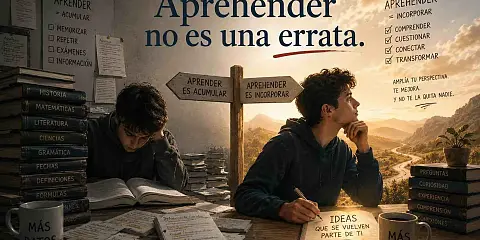
Apprehending is not a typo
July 3, 2026
A Krausist in Cádiz
My great-great-grandfather, Alfonso Moreno Espinosa, held a chair at the Instituto de Cádiz and was close to Krausism. A movement that gave rise to the Institución Libre de Enseñanza (the Free Institution of Education), probably the most ambitious educational experiment Spain has ever produced, and the prologue to the Generation of '98. The Krausists believed in an idea that was radical for their time, and apparently for ours too: that the teacher is not there to fill heads, but to spark curiosity. Not to hand down answers, but to teach students to love the search for truth.
One hundred forty-eight years later, I not only urge my students at IE Business School to use AI, but I ask them, as their final assignment, for the URL of the ChatGPT conversation they used to answer the question I set them a month in advance. The two things may seem unrelated, but for me they are intimately connected.
How many teachers do you remember?
Try this exercise. Close your eyes and try to count how many of the teachers who passed through your life left a real mark on you. Not the ones who taught you, but the ones who changed something inside you. If you get to five, you were extraordinarily lucky.
The ones you remember were, in all likelihood, not instructors. They were mentors. And the difference is not semantic. An instructor transmits a subject. A mentor teaches you to think with it. An instructor fills. A mentor ignites.
Mari Nieves was a mentor. A Castilian, from Valladolid. Mother of seven and a true lady. She taught literature. But to say she "taught" it falls far short: she vibrated with it. She never expected us to learn things by heart. She wanted us to read, to feel, to make other people's words our own until we could find our own.
One day, in her class, I described Góngora's style as floripondioso (roughly, "frilly-flowery"). The word doesn't exist. But Mari Nieves congratulated me for coming up with a term that said everything about the author. She didn't correct me. She didn't ask me for the textbook definition of culteranismo. She understood that if a student is able to invent a word that captures the essence of a literary style, that student has apprehended something no textbook will ever take away.
On another occasion she dared to do something that would be unthinkable today: she set an exam with ten questions, seven of which were about Don Quixote. Not about Don Quixote as a syllabus topic, but about Don Quixote as a book we were supposed to have read. She failed 90% of the class. Because 90% had limited themselves to studying what others said about it. They confused learning about the book with learning from the book. The same confusion, by the way, that repeats itself today every time a student asks ChatGPT to summarize an article instead of reading it.
Aprehender, with an h
Aprehender — with an h, and no, that's not a typo (Spanish sets it apart from aprender, to learn; in English, to apprehend) — is something different from learning. Learning is accumulating. Apprehending is incorporating: making an idea yours until it becomes part of you and you can no longer think without it. Once you have apprehended something, it becomes a building block for what comes next. It broadens your perspective. It makes you better. And nobody can take it away from you. Floripondioso was apprehending. Class notes were learning.
Pythagoras was a mathematician, a philosopher, a musician and something like a spiritual leader. Leonardo da Vinci painted, designed war machines, studied anatomy and wrote treatises on hydraulics. They weren't exceptions in their time; they were the natural product of educational models that didn't conceive of knowledge as a set of watertight compartments.
What have we done since then? Hyper-specialized to the point of absurdity. A doctor today isn't a doctor of a patient, but of an elbow. A lawyer doesn't understand law, but clause 14.3 of the distribution agreement for the Asian market. And a teacher — and this is where it hurts — doesn't teach people to think. They teach them to accumulate disconnected facts about a subject that never hooks up with the ones next door, nor with the life that awaits their students outside the classroom.
Ortega put it better than anyone in Meditations on Quixote: "A concept is nothing more than the organ with which we apprehend things. Whoever gives you a concept, whoever gives you an idea, enlarges your life and expands the reality around you." He isn't giving you information. He's giving you life. That is the difference between an instructor who fills and a mentor who ignites.
Cervelló's silence
There was a professor in my master's program who understood this too. José María Cervelló ran a course called Advisory Policy that on the surface was a collection of disconnected sessions. But they had an invisible thread: making us see the contradictions of the system. In one of them he anticipated something we would live through years later: that our constitutional system wasn't prepared to respond if a region decided to unilaterally upend the whole game. He walked us through every conventional legal remedy until there were none left. And when we reached the limit, not knowing what else to propose, he looked up and asked: "And then what? Do we send in the army?"
No one could answer. But we all apprehended something that day. Not an answer, but the ability to keep asking questions when the answers run out. That isn't memorized. It's incorporated.
Cervelló provoked uncomfortable silences. He left time for doubt to creep into our heads. So we could consider that the other person might also be right. That their opinion opened angles ours hadn't contemplated. Pure maieutics: not giving you the answer, but forcing you to find it. What Socrates did in Athens, what the Krausists did in their schools, what Harvard later turned into the case method. The same principle with different interlocutors over twenty-five centuries. Cervelló would never have banned a new tool. Because he didn't give us answers; he helped us formulate the right question.
Same movie, higher resolution
When a tool arrives that threatens to make the accumulation of facts irrelevant (because AI summarizes, classifies and regurgitates information better than any human), the hyper-specialized teacher panics. Because what that tool threatens isn't education, but their model of education. The one that consists of being the guardian of a knowledge that no longer needs a guardian.
The reaction is always the same: ban it.
In the mid-seventies, a survey by the journal Mathematics Teacher revealed that 72% of math teachers in the United States were opposed to seventh graders — twelve- and thirteen-year-olds — being allowed to use calculators in class. In 1986, a group of educators staged a formal protest at the conference of the National Council of Teachers of Mathematics. Their argument was impeccable on the surface: if you give them a calculator, they'll never learn to calculate. A decade later, every state allowed them in exams and the debate had become an anecdote.
Exactly the same thing happened with the Internet. I remember well the debate that opened at IE Business School more than twenty years ago, when we began to consider offering online courses. The arguments were the usual ones: the personal relationship will be lost, the student won't make an effort, the teacher will become expendable. Today, Coursera was born at Stanford, edX was founded by Harvard and MIT, and the best cohorts in many master's programs are the ones taught remotely.
And now AI. Same movie, but in 4K. And with the same instinctive response: ban it instead of thinking about how to integrate it. Because thinking is very stressful, you know.
What the data say (and what they don't)
In June 2025, the MIT Media Lab published a preprint titled "Your Brain on ChatGPT" that set off media alarm bells. The study monitored the brain activity of 54 participants via electroencephalography over four months, divided into three groups: those who used ChatGPT to write essays, those who used search engines, and those who wrote with their brains alone. The results were striking: 83% of ChatGPT users couldn't quote from memory a single sentence of what they had written just minutes earlier. Neural connectivity in the AI group was up to 55% lower than in the group writing unassisted.
Three clarifications are in order that rarely make the headlines. First: these are 54 participants from Boston's academic environment; it's not a sample that allows for sweeping generalizations. Second: it's a preprint, not a peer-reviewed study; its own authors warn that the conclusions should be treated with caution. And third, the most important: the study measures what happens when you use AI as a substitute for thinking, not as a tool for thinking better. That distinction changes everything.
Because in parallel, a Chinese-Australian study published in the British Journal of Educational Technology (this one peer-reviewed) coined a term that deserves to stick: "metacognitive laziness." Fan and his colleagues observed 117 Chinese students as they wrote essays with and without ChatGPT. The AI group got better formal grades, but showed no greater knowledge gain or ability to transfer what they had learned to new problems. The students copied and pasted the AI's answers even when the system was expressly designed not to write for them. It's not that the tool is bad. It's that no one had taught them how to use it.
And a third study, from Wuhan University, confirmed with 580 university students what the previous ones hinted at: dependence on AI correlates directly with a reduction in critical thinking, through a mechanism as simple as it is devastating: cognitive fatigue. The more you delegate, the less thinking tires you. And the less it tires you, the less you think.
The URL of the question
When I became a professor, I decided to try to do things differently. I wasn't interested in them remembering the concepts I talk about in class, but in them thinking differently when they walked out. In them discovering the connections between things. In them looking for the whys. Because the more connections someone discovers, the closer they get to the true meaning of what they're studying. And the more they make it their own.
That's why I haven't given exams in many years. I don't believe in them. For a long time I replaced them with four final questions that my students had to develop over a month, with a strict length limit: one side of a page for the answer, another for the references. I wasn't interested in them repeating what they had heard, but in checking whether they had learned to separate the essential from the incidental and were able to synthesize it. It was my way of measuring whether they had apprehended something.
Today I ask them for something else. I don't want the answer. I want the URL of their conversation with artificial intelligence. Because AI isn't a threat to the teacher, but an excellent opportunity. Everything shows up in that conversation. A student who starts by asking ChatGPT "write me an essay on digital transformation in banking" has outsourced their brain. On the other hand, when I see someone who starts by asking what analytical frameworks exist for assessing the digital maturity of a European bank, who questions the sources the AI offers, who rephrases the question three times because they're not satisfied with the answer, and who ends up building their own argument using the tool for what it is — an assistant, not an author — I know that person has apprehended something. Probably more than if they had written the essay by hand after a quick Google search.
I understand that you can't put an artificial intelligence tool in the hands of a five-year-old. But neither can you teach with your back turned to what will, with absolute certainty, be the technology your students will face throughout their professional lives. And if your response to that is to ban it, instead of rethinking what you teach and how you teach it, the problem isn't the tool. It's you.
I've spent thirty-five years looking for the same symptom in my students' eyes. It's hard to describe but impossible to mistake: at some point in the class they stop looking at you and start seeing. They've stopped following your speech and started thinking for themselves. When that happens, they no longer need you to be there. Your mission is accomplished.
What is really at stake
But there's something more, and it's important to say it.
A deep understanding of things isn't just an intellectual or professional advantage. It's a form of freedom. Hannah Arendt put it bluntly: the ideal subject of totalitarian rule is not the convinced fanatic, but the person for whom the distinction between fact and fiction, and between true and false, no longer exists. Someone who doesn't think rigorously doesn't just perform worse; they are more vulnerable. More manipulable. More dependent on whoever tells them what to believe.
When a student delegates their thinking to a machine without understanding what the machine gives back, they're not only missing an opportunity to learn. They're giving up the ability to distinguish the true from the plausible. In a world where AI generates texts indistinguishable from those written by humans, that ability isn't an academic luxury. It's a condition for survival.
That's why I deeply believe that teaching people to think isn't about helping them complete a curriculum. It's a moral obligation.
The MIT data seem to show that delegating thinking to the machine causes atrophy. Those from Peking University add that without metacognition, intellectual laziness sets in. But none of these studies shows that the tool is the problem. What they show is that, as has been the case since the printing press was invented, the problem is us, the ones who teach. Because when your educational model consists of being a dispenser of answers, any machine that dispenses answers faster than you makes you expendable. But when your model consists of awakening curiosity, of making a student want to know rather than have to know, no machine replaces you. It amplifies you. Which is what machines were always for.
My great-great-grandfather applied the Socratic method in the Cádiz of 1878. One hundred forty-eight years later, the method is still the same. Only who answers has changed.
Socrates, the greatest teacher humanity ever produced, was quite clear about it. The key lies in learning to ask the questions that bring you closer to knowledge. That's why, when I read the things being said about AI and education, I think he would be deeply disappointed at how little we have learned from his legacy.
Our latest news
Interested in learning more about how we are constantly adapting to the new digital frontier?
Corporate news
October 7, 2026
Sngular grew by 7.2 per cent in the first half of 2026


Strategy
September 29, 2026
Would you hand your wallet to Zuckerberg?