
Scaling AI Without Losing Control

February 12, 2026
Gemini Enterprise: The Key to Governing and Powering the Rise of Autonomous Agents
When we analyze where Artificial Intelligence is heading, there is a term that is being heard more and more frequently and which, with total certainty, will dominate much of the technological conversation throughout 2026: "Autonomous Agents."
In just a few years, we have moved from being surprised by the ability of conversational assistants to give us useful answers, to considering much more ambitious architectures. We are no longer just looking for a chat interface; we are starting to design systems that can trigger automatically, work in the background, and be customized in such a way that the human role shifts toward supervising the produced results.
Evolution of the Agent Ecosystem
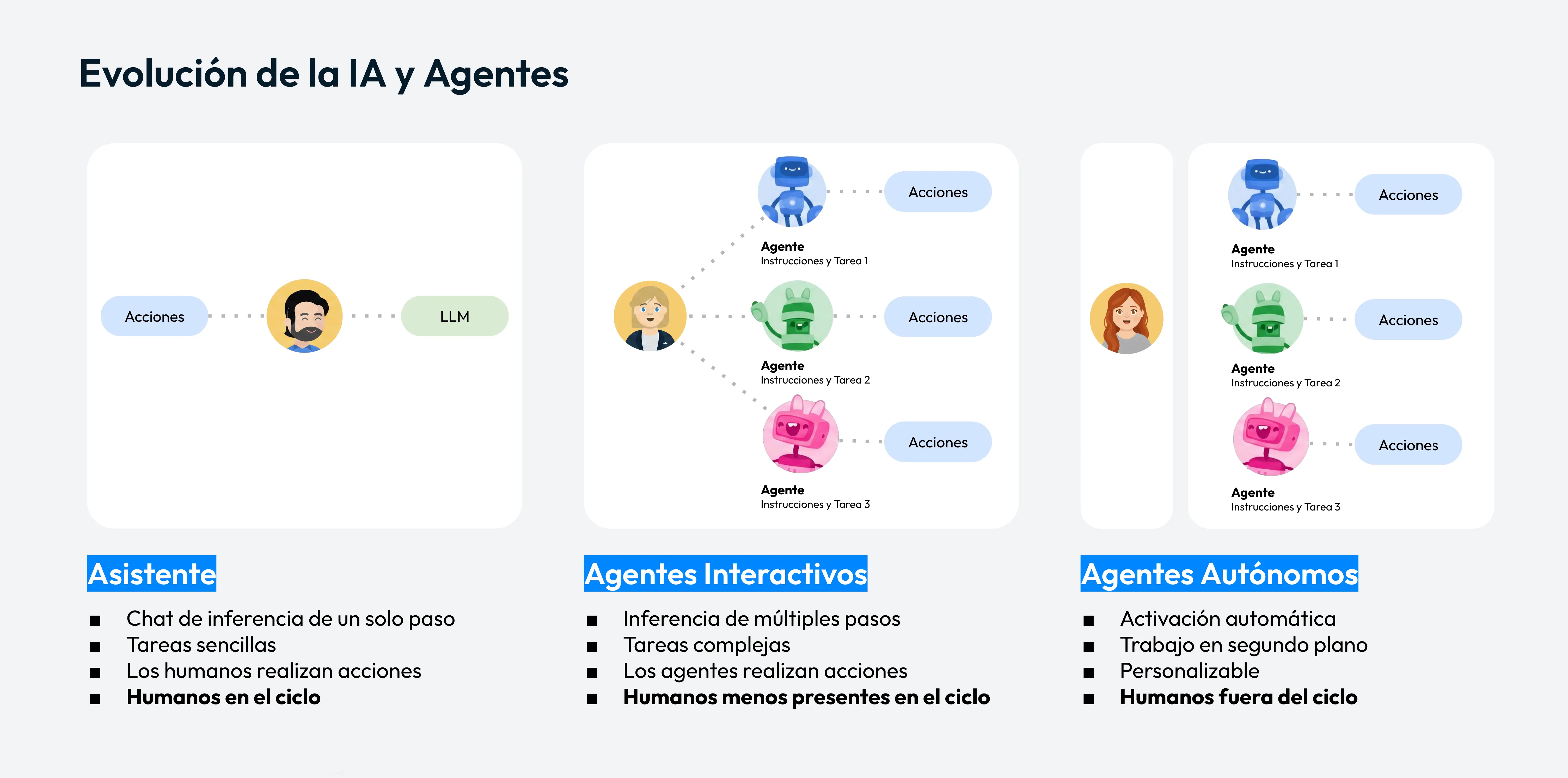
It is important to understand that we are not facing a technology that comes to displace previous ones, but rather an evolution that expands our range of possibilities. The assistant is not going to disappear, nor will the interactive agent; we simply now have a new level of autonomy to cover new use cases more easily.
Assistants have been our starting point. They are ideal for direct interactions where the user guides the conversation to obtain a specific response or content.
Throughout 2025, the concept of the Interactive Agent became popular and began to expand. These are agents capable of following a series of instructions to execute complex tasks that require performing various sequential actions and interacting with other systems or agents. Here, the agent not only responds but acts, and the human remains within the process, controlling and validating it step-by-step.
The frontier that has now been crossed is that of Autonomous Agents. Unlike the interactive model, the autonomous agent can execute processes independently. It’s not that the human is out of the loop, but rather positioned above the process, supervising the outcome of work that runs automatically in the background.
We have reached a point of technological versatility that allows us to approach problems in different ways, depending on the level of involvement we want to have in each task.
New Challenges
The fact that we can already design processes with autonomous agents does not mean we have solved the operational foundations of Artificial Intelligence. In many organizations, enthusiasm for the technological vanguard coexists with a pending task: consolidating the governance, democratization, and security of these tools.
Consider a common scenario: after months of adjustments, a user manages to get an assistant connected to corporate data sources to work accurately. It is a resounding success, but it is an isolated success. The real challenge arises when we try to transform that individual solution into an asset shared by hundreds of people. How do we scale that knowledge without losing control?
Even when we find a way to share these tools—something that is rarely as trivial as it seems—critical questions arise that every organization must answer:
-
Security and Privacy: How do we guarantee that every response respects user permission levels and does not become an unintended security breach?
-
User Empowerment: How do we allow business areas to create and distribute their own agents without technical teams becoming a constant bottleneck?
-
Fragmentation Management: How will we govern an ecosystem of dozens or hundreds of agents developed with heterogeneous technologies or deployed across different clouds?
For these reasons, the greatest immediate challenge does not lie solely in the power of the models. Real success will depend on our ability to orchestrate this ecosystem, ensuring privacy and establishing maturity metrics that allow us to understand the real impact and use of AI within the company.
The Need for an Agent Platform
The analysis of current operational challenges suggests that AI maturity in the enterprise will not come from isolated tools, but from the adoption of comprehensive infrastructures. For these solutions to be sustainable, they must be articulated around Flexibility that allows for interoperability between models; that is, the organization must be able to integrate the latest technological innovations without being forced to restructure its workflows with every market advancement.
From a scalability perspective, these platforms must act as enablers of internal talent. This involves integrating No-code capabilities that allow business profiles to develop or deploy solutions without a heavy reliance on IT teams. In this way, value creation is democratized, allowing the expert knowledge of each department to be translated into specialized agents in an agile manner.
The strategic value of these tools lies fundamentally in their capacity for Integration and Grounding. An agent is only useful if it operates within the real context of the organization, which requires a robust connection to internal data and, when the analysis demands it, to external information sources. Furthermore, this operation must take place in a native Multimodal environment, where managing various asset formats (text, image, or video) is a fluid and transparent process for the end user.
Finally, any deployment of this type must be subject to a Control and Privacy framework. Agility in innovation is not mutually exclusive with strict governance; on the contrary, a solid platform must ensure that AI use aligns with the organization's security and compliance policies. It is this set of capabilities that defines what we understand today as a robust Agent Platform.

Gemini Enterprise
When defining and reviewing their roadmap, organizations face a fundamental dilemma: do we develop our own architecture from scratch or adopt a consolidated infrastructure?
It is true that, in niche scenarios with very unique technical requirements, it may make sense to opt for in-house development to maintain absolute control over every component. However, for the vast majority of companies, this path carries significant operational risk. The effort of building and maintaining a proprietary architecture often forces the organization to invest more resources and talent in the infrastructure itself than in solving the business use cases that motivated the investment.
This dispersion of effort not only raises costs but also drastically extends the timelines for obtaining tangible results. In a market where technology evolves at a frantic pace, having an enterprise solution allows for delegating technical complexity to focus all strategic energy on what adds real value: process efficiency and business logic.
However, the differentiating factor lies not only in the speed of deployment but in the guarantees of evolution. Having the backing of a platform that ensures constant updates of models, without compromising or breaking previous integrations, becomes a critical competitive advantage. It is the difference between managing a tool that becomes obsolete in months or having an ecosystem that grows and strengthens at the same pace as the technology itself.
At this point in the analysis, proposals such as Gemini Enterprise establish themselves as the technical answer to the complexity of governance and scaling, acting as a unified intelligent interface under the following pillars:
-
Next-Generation Models: Access to advanced multimodal capabilities, such as Gemini 3, allows for addressing previously unreachable business problems, processing video, audio, and large volumes of data under a single execution logic.
-
Operational Democratization via No-code Tools: For AI to be a real engine of efficiency, it cannot be the exclusive domain of technical departments. Allowing Marketing or Finance users to configure their own agents ensures that business knowledge translates directly into automation.
-
Specialized Agents from Day One: Deployment is accelerated thanks to preconfigured agents for critical tasks—such as deep research (Deep Research), document analysis (NotebookLM), or coding assistance—allowing for immediate operational results.
-
Interoperability and Extended Grounding: The platform eliminates information silos by integrating with hybrid environments such as Google Workspace, Microsoft 365, Salesforce, SAP, or BigQuery. This ensures that AI always operates with the precise context of the organization.
-
Governance and Data Sovereignty: Centralized management allows for supervising and protecting every interaction, ensuring that innovation meets security requirements and that control over information always remains in the hands of the company.
Ultimately, the choice of platform is a decision about future stability. It is about choosing a partner with the investment capacity necessary to lead the transition toward autonomy under the strictest Control and Privacy standards, allowing the company to be prepared today for what technology will demand tomorrow.
Change and Support
As technology becomes simpler, the focus shifts from being purely technical to focusing on transformation and change management. Success no longer depends only on the technical solution, but on our ability to assimilate AI as a tool for real efficiency.
To overcome the natural resistance to this evolution, the most important tools are not technological, but human: Communication, Training, and Leadership. This is where having the expert support of a technology company like Sngular becomes critically valuable.
Experience in implementing these solutions shows that maturity is not achieved simply by installing software, but by integrating technical excellence with a human vision. A partner like Sngular provides the methodology necessary for adoption to be deep, ensuring that the move toward process autonomy is, above all, an improvement in the capability and efficiency of the people who make up the organization.
Our latest news
Interested in learning more about how we are constantly adapting to the new digital frontier?

Insight
September 17, 2026
The Role of Junior Professionals in the Age of AI: Perspectives, Challenges, and the Future of Talent in the Tech Industry

Insight
July 27, 2026
Nebrija Education Group scales its student services with Jira Service Management: a unified, data-driven experience for more than 15,000 students
Tech Insight
July 1, 2026
The New Era of Agentic Programming: Antigravity 2.0 and Sngular Gen

Tech Insight
June 25, 2026
Let Gemini Do It: Generative AI for Businesses on Google Cloud