
Nebrija Education Group scales its student services with Jira Service Management: a unified, data-driven experience for more than 15,000 students

July 27, 2026
Nebrija Education Group, an international educational institution with a community of more than 15,000 students and over 50,000 alumni, needed to evolve its service model to respond to an increasingly complex reality: multiple entities, departments, services and user profiles operating within the same group.
Until then, many requests were managed through an in-house platform, email and some in-person processes. This fragmented approach made requests harder to track, led to duplication, forced teams to consult information across different systems and made it difficult to understand what was actually happening within each service.
To address this, Nebrija partnered with Sngular to design the functional architecture of a platform capable of centralising operations, adapting to the needs of each audience and turning request data into useful insights for decision-making.
Jira Service Management became the core of this new model, supported by Refined, Elements Connect, Power BI and other capabilities within the Atlassian ecosystem. The goal was not simply to modernise a tool, but to build a service experience that was clearer and more contextual for users, more efficient for teams, and far more measurable and scalable for the organisation.
The challenge: centralising very different services on a single platform
Nebrija Education Group supports users with very different needs and digital habits, including university students, vocational education students, residents, teaching staff, and administrative and support teams.
The variety of services was also a challenge. The platform needed to manage everything from academic and administrative processes to technology requests and residence-related services, while delivering an experience tailored to each type of user.
The challenge was to centralise this wide range of services without forcing every user and department to work in exactly the same way.
There were also several operational issues:
- Requests were spread across different channels.
- There was limited visibility into their status and progress.
- Requests were often duplicated because users did not know whether they were already being handled.
- Information was scattered across systems, departments and reference sources.
- It was difficult to determine how long each process took and how many people were involved.
- There were no shared metrics for analysing services and driving improvements.
Nebrija needed a common platform for the entire group, but one flexible enough to respect the specific needs of each area, service and user group.

A functional architecture designed around Nebrija’s reality
Jira Service Management at the core of operations
Jira Service Management made it possible to centralise requests, define processes, configure queues and permissions, automate tasks and improve end-to-end traceability.
Every interaction began to be recorded on a single platform, creating a shared view of the work and making it easier for teams that had previously operated in greater isolation to collaborate.
A single entry point, tailored to each audience
With Refined, Nebrija created clearer, better-structured service portals aligned with its visual identity.
Although the entry point is shared, the experience can be adapted to each user group. A student, resident, lecturer or employee does not see the same services or necessarily use the same forms.
This makes it possible to centralise without losing personalisation: one platform behind the scenes, with different front-end experiences for each audience.
More context, without leaving Jira
One of the main drivers of adoption was ensuring that Jira delivered an immediate benefit to teams.
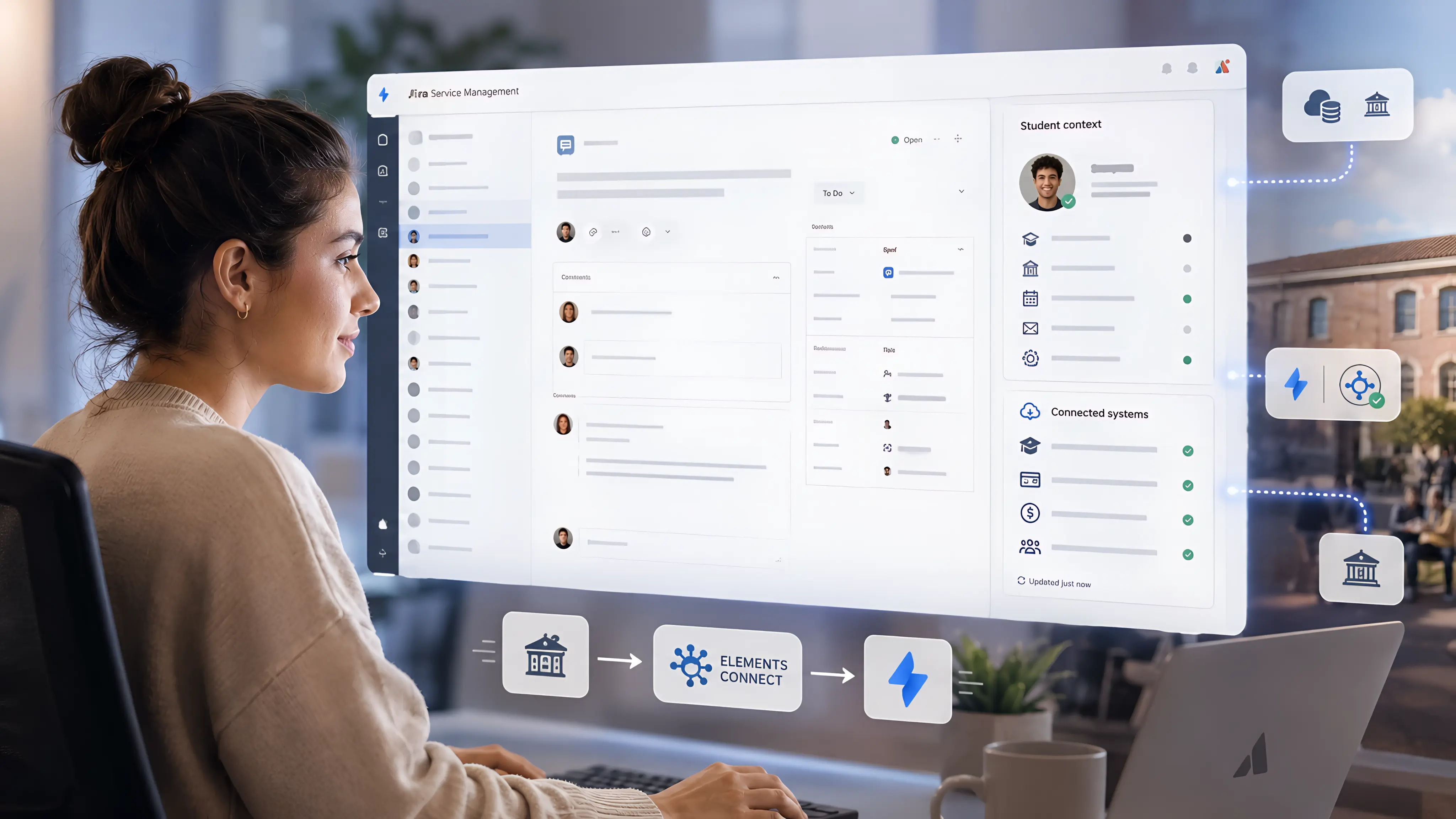
Using Elements Connect, the platform was integrated with Nebrija’s internal systems so that relevant student context could be displayed directly within each request.
This allows agents to understand each case from the outset, without switching tools or carrying out manual searches before they can begin resolving it.
From having no metrics to managing with data
Centralising requests made it possible to capture the full lifecycle of each service in a structured way.
Through Power BI, Nebrija can analyse this information and answer questions that were previously difficult to address:
- How long does each process really take?
- Where do the main bottlenecks occur?
- What volume does each department handle?
- Which services experience seasonal peaks?
- Where are the main opportunities for improvement?
- Which changes are successfully reducing delivery times?
The reports enable Nebrija to analyse operations at both an aggregated and comparative level, identify patterns and make data-informed decisions instead of relying solely on individual perceptions.
A phased implementation focused on adoption
The project was not approached as a single organisation-wide rollout, but as a gradual transformation.
It began with student-related services, with new areas added through pilots tailored to their specific requirements.
The process included:
- Defining each department’s workflows.
- Configuring portals, forms, queues, permissions and automations.
- Delivering training sessions for the different teams.
- Using metrics to identify results and support further expansion.
- Appointing representatives or “champions” in each department to gather requirements and introduce improvements.
This approach also helped address one of the project’s main challenges: cultural change. Adoption depended not only on introducing new technology, but also on helping students and professionals move away from long-established channels and habits.
A better experience for those making requests and those resolving them
For students, residents and internal staff, the new model provides a clearer entry point to services and greater visibility into the status of their requests.
For agents, it means more structured processes, better information and less manual work.
The platform also helps break down silos between departments. Teams can collaborate more easily, understand how different processes are connected and work with a shared view of service delivery.
Each request is no longer an isolated interaction, but part of a traceable, connected and measurable operation.
Results: greater efficiency and growing adoption
The platform is already supporting several areas across Nebrija, including:
- Student Administration.
- Technology services for teaching staff and internal employees.
- Institutes.
- Residences.
The platform continues to expand progressively across other areas of the group.
During the 2024/25 academic year, the model handled more than 74,000 requests and reached:
- More than 140 agents.
- More than 1,800 internal requesters.
- More than 22,000 external requesters, mainly students.
- An overall rating of 4.14 out of 5.
A comparison of the 2025/26 academic year with 2024/25 also shows significant improvements:
- 56% reduction in first response time.
- 38% reduction in the lifecycle of a request.
- 0.5% increase in the overall rating.
- 7.5% increase in the volume of requests managed.
The reduction in response times is not the result of teams being asked to work faster. It comes from better processes, more context and fewer manual steps.
The reduction in average resolution time is directly linked to the removal of manual lookups in external systems. Agents are not faster because they are being asked to work harder; they are faster because the system provides the information they need at the right time.
A foundation for continuing to transform service delivery
With the platform now firmly established, Nebrija is expanding the model to new areas such as Marketing, Human Resources, Procurement, Credit Recognition and Alumni Services.
The next steps also include:
- Connecting additional data sources through Elements Connect.
- Expanding automations tailored to each department.
- Implementing Confluence as a shared knowledge base for the group.
- Increasing self-service and reducing administrative workload.
- Introducing Rovo capabilities to provide more contextualised responses based on each user.
The long-term goal is for service-related communication across Nebrija to move progressively through Jira Service Management, creating a consistent experience throughout the organisation.
From managing requests to continuously improving services
The collaboration between Nebrija and Sngular has enabled the organisation to move from a fragmented, hard-to-measure service model to one that is centralised, flexible and data-driven.
The value of the project lies not only in the technology itself, but in the functional architecture connecting experience, processes, information and analytics.
With this foundation in place, Nebrija can better support a highly diverse community, make work easier for its teams and gain a more accurate understanding of how its services are evolving.
Because improving service is not simply about resolving more requests. It is about learning from every interaction to deliver an increasingly better experience.
Our latest news
Interested in learning more about how we are constantly adapting to the new digital frontier?

Tech Insight
July 1, 2026
The New Era of Agentic Programming: Antigravity 2.0 and Sngular Gen

Tech Insight
June 25, 2026
Let Gemini Do It: Generative AI for Businesses on Google Cloud

Tech Insight
June 18, 2026
No Data, No AI: Agentic Data Cloud and Data Sovereignty

Tech Insight
June 16, 2026
Generative UI: When AI Architecture Builds the Interface, Not Just the Text