
Infinite Worlds: When the best graphic is your imagination

February 5, 2026
The Generative Audio-Game Revolution That Aims to Redefine Immersion
Imagine this. You are on the subway, headphones on, eyes closed. The winter wind lashes against the castle walls while wood creaks beneath your feet. A voice whispers to you: “The zombies are breaking down the door.” You have a dagger and 90 health. What do you do?
There is no screen. There are no controllers. Only your voice, your imagination, and an adventure that responds to every decision you make. This is the Infinite Worlds project.
The Mirage of Hyperrealistic Graphics
When Mike Wheeler and his friends sat in the basement playing Dungeons & Dragons in Stranger Things, they did not need photorealistic graphics to feel terror before the Demogorgon. They only needed to recreate the scenes in their minds, some dice, a character sheet, and a good narrator. Each player visualized the monster differently in their mind, and that personal version was more powerful than any render. The theater of the mind has always been the most immersive gaming platform ever created.
But at some point, the industry forgot that lesson.
For four decades, the video game market has pursued a single obsession. Producing the most realistic graphics. We have invested billions to render every pore of a character’s skin, every drop of sweat, every reflection of light on metallic surfaces processed through real-time ray tracing. The latest AAA titles require GPUs that cost more than entire consoles, studios with budgets of two hundred million dollars, and teams of hundreds of 3D artists working for years.
The result is visually impressive games that, paradoxically, often sacrifice the player’s own creativity on the altar of photorealism. In that technological race we lost something fundamental. We stopped asking the player to use their most powerful graphical tool. Their imagination.
And there is something more. Current games demand almost one hundred percent of your visual attention and manual skill. This excludes millions of people who cook, travel on crowded public transport, have visual or motor disabilities, or simply do not want to memorize combinations of twelve buttons to execute a combo.
According to the World Health Organization, there are approximately two billion two hundred million people with some degree of visual impairment in the world (https://www.who.int/es/news-room/fact-sheets/detail/blindness-and-visual-impairment). For them, the video game industry practically does not exist. The few accessible games are usually versions adapted afterward, not experiences designed from scratch to work without a screen.
A New Way to Play
Infinite Worlds is a truly interactive generative audio-game platform project. It is not an audiobook, because you decide what happens. It is not a conversational chatbot, because there are rules, real danger, and mechanical consequences. It is not a podcast, because every session is unique and unrepeatable.
It is the fusion between the classic Choose Your Own Adventure books of the eighties, a tabletop RPG game master with decades of experience, and the power of modern Large Language Models. All of this wrapped in an immersive soundscape generated dynamically that transforms your subway ride into an expedition to unexplored worlds.
While the industry obsesses over one hundred and twenty frames per second and 8K, Infinite Worlds proposes something radical, audio-first gaming. Not as added accessibility, but as a fundamental design philosophy.
This implies procedural sound design where each action generates contextual sound effects, with the echo of a cave differing from that of a stone hall. Cinematic narration adapts in real time, modulating tone, pace, and tension according to the narrative moment. The interface is completely hands-free, controlled by voice with natural language processing, and may include optional haptic feedback through subtle vibrations at key moments to reinforce immersion if, for example, it runs on a smartphone.
An Invisible Game Engine Under the Hood
One might think that this is simply “talking to Gemini with sound effects”.
Nothing could be further from the truth. The idea is to create an Invisible Game Engine that executes real logic when the player acts. When you say “I attack the dragon,” the system does not improvise a generic response, it calculates probabilities based on your inventory, manages your health and sanity, checks the enemy’s resistances, generates sound effects synchronized with the action, and narrates the result in a cinematic way.
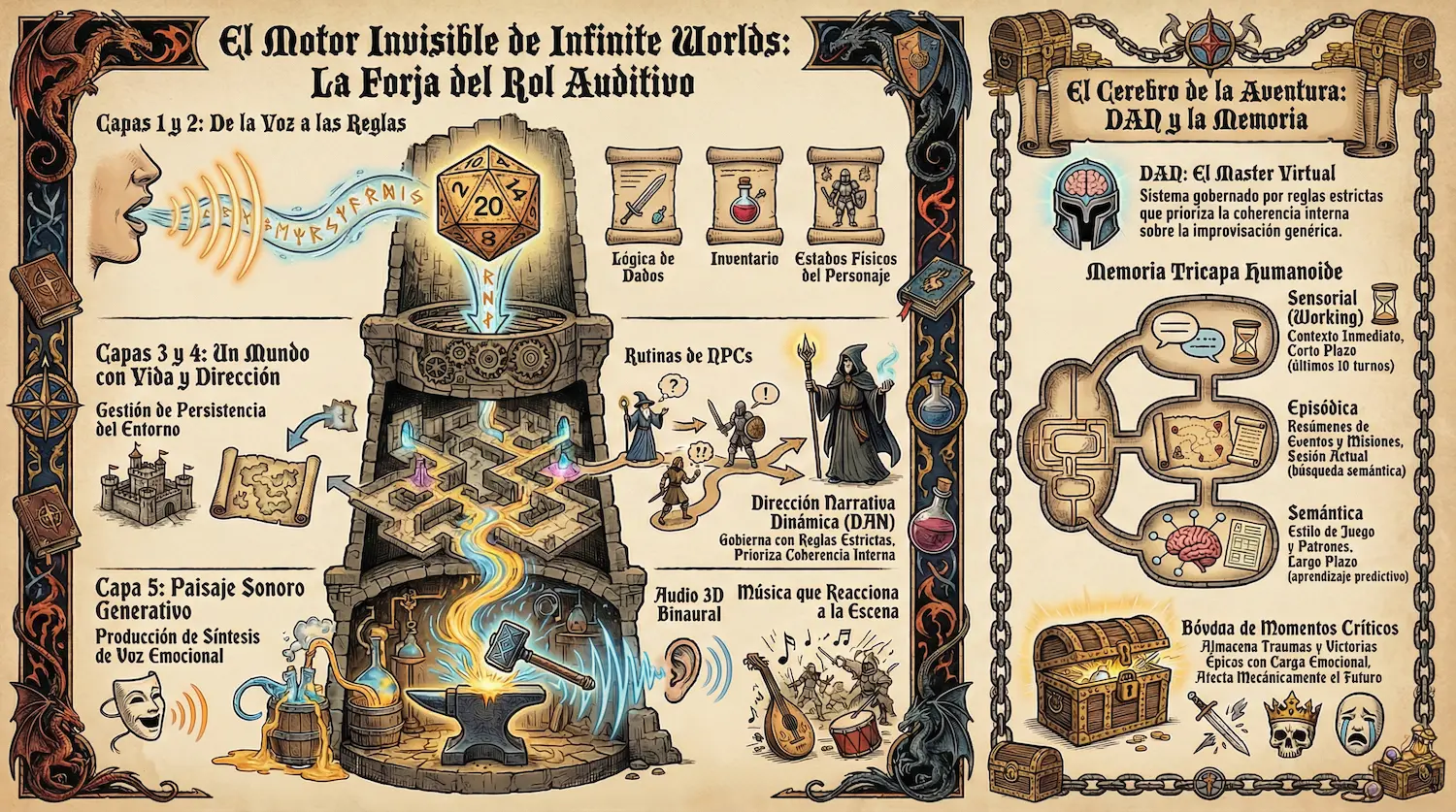
The system is structured in specialized layers that work together. The first layer processes your input through Whisper models optimized for low latency, interpreting your intent with contextual precision. This layer distinguishes between “I run toward the door” and “I run from the door”, and handles ambiguities through natural conversational clarifications.
The second layer contains the core of the game engine, with a conflict resolution system based on virtual dice that works, for example, like in classic role-playing games. Here the inventory is managed with weight, durability, and item properties, along with character states such as health, sanity, hunger, fatigue, and status effects. It also implements narrative physics for falls, fire damage, drowning, and poisons, in addition to a progression system with experience, levels, and unlockable skills.
The third layer simulates the state of the world, including day and night cycles, seasons, and the persistence of changes in the environment. If you burn a forest, it remains burned. NPCs have routines, memory of your previous actions, and their own agendas. There could even be a dynamic economy where prices fluctuate according to supply and demand.
The fourth layer is where DAN, the Narrative Adventure Director, comes in, taking care of generating NPC dialogues consistent with their established personalities, procedural creation of dungeons, puzzles, and encounters, and dynamic adjustment of difficulty based on your performance.
Finally, the fifth layer presents all of this through neural voice synthesis with contextual emotions, real-time mixing of sound effects, binaural 3D audio spatialization for immersion, and adaptive music that responds to the emotional state of the scene.
DAN, the Narrative Adventure Director
DAN is not a generic chatbot, but a virtual game master governed by strict rules and a conflict resolution system inspired by classic role-playing games.
Its design prioritizes consistency over overflowing creativity. DAN prefers the internal coherence of the world over surprising responses. If you established that magic does not exist in your session, DAN cannot introduce a wizard just because it would be interesting. The rules of the world are respected religiously.
Each action has weight and persistent consequences. If you kill the village blacksmith, there will be no one to repair your sword. If you make powerful enemies, they will hunt you. If you take an oath, the system will remember whether you keep it or break it. Inspired by modern narrative games, failures do not end the story, but divert it in unexpected directions. Failing to steal a key may mean that a guard discovers you, starting a thrilling chase instead of a simple game over.
DAN analyzes your decision history to calibrate challenges through a dynamic challenge rating system. If you constantly avoid combat, it increases opportunities for diplomatic resolution. If you are a berserker, it prepares more complex tactical encounters.
Technically, DAN operates through an architecture of specialized prompts that run in sequence. First, the Master Prompt defines identity, tone, and fundamental constraints. Then, the World Context Prompt injects information about the current state of the world. The Character Sheet Prompt provides statistics, inventory, and character state, while the Narrative Arc Prompt maintains coherence with the story’s objectives. The Safety Prompt avoids inappropriate content while maintaining immersion, and finally the Output Format Prompt structures the response for audio integration.
Each prompt is continuously optimized through advanced prompt engineering techniques, including few-shot learning and chain-of-thought reasoning, constantly refining the experience through machine learning from thousands of real game sessions.
Memory, a Three-Layer Artificial Brain
One of the biggest challenges of current AI is context limitation. Language models have a token window that, although large—up to two hundred thousand in recent models—is not infinite. Adventures that last weeks or months need a more elegant solution.
Infinite Worlds aims to solve this with a three-level memory architecture that mimics the functioning of the human brain. The first level functions as sensory memory or working memory, keeping the last five to ten turns of conversation directly in the LLM’s context window. This provides instant access to immediate context.
The second level implements episodic memory for the current session, storing vector summaries in a database that allows recalling what happened thirty minutes ago even if it is outside the context. These summaries are retrieved in less than one hundred milliseconds through semantic search and have formats like “In the Black Duke’s castle, you defeated his guards and freed the prisoner.”
The third level constitutes semantic memory or long-term memory, where abstract concepts from all your adventures are stored through embeddings in vector space with clustering. This layer learns your play style, identifying patterns such as the player prefers stealth over frontal combat or tends to trust female NPCs, enabling predictive personalization of future content.
And here comes the brilliant part. High emotional impact moments such as traumas, epic victories, betrayals, or oaths are stored in a Critical Memory Vault that never degrades. These memories have priority retrieval, activating upon contextual triggers. Each one carries its emotional load encoded on a scale from one to ten for joy, fear, anger, and guilt, along with specific activation conditions. They can apply temporary buffs or debuffs that mechanically affect the game.
Technically, this is implemented through an event tagging system during gameplay, real-time sentiment analysis to detect critical moments, semantic compression that distills the essence of the moment into fewer than one hundred tokens, and contextual indexing for instant retrieval. If your character survived a fire three real months ago, the system can trigger a flashback when you see fire again, with temporary penalties to your sanity rolls. This creates emotional continuity impossible in traditional games.
The Quixote Principle, Radical Freedom Without Infinite Sandbox
Unlike traditional video games, limited by assets that someone had to model in 3D, render, animate, and program, Infinite Worlds allows unprecedented genre fluidity. Do you want to invoke sci-fi technology in the middle of the Middle Ages? The system does not forbid it with an action not allowed message. It adapts it, interprets it, and generates narrative consequences consistent with that new hybrid reality.
Let’s imagine a real example. A player says “I take out my smartphone and record the dragon.” A traditional system would respond with a brief Action not recognized. Infinite Worlds, on the other hand, could narrate “You pull a strange silver artifact from your tunic. The dragon, intrigued by this shiny object it has never seen, approaches. Roll a twenty-sided die to see if you can capture its image before it attacks.” A camera sound effect is heard. “Result: fourteen. The flash startles the dragon, which steps back. You have gained a momentary advantage. What do you do?”
Like Don Quixote transforming windmills into giants, you can transform your adventure into whatever your imagination dictates. But unlike an infinite sandbox without constraints, which quickly becomes chaotic and meaningless, DAN acts as a creative interpreter who incorporates your madness into the internal logic of the world.
Absolute freedom can be paralyzing. That is why Infinite Worlds will implement what we call invisible guardrails. Players can preselect adventure tones such as cosmic horror, epic fantasy, cyberpunk noir, or space western. Power limits are traditionally progressive. You start vulnerable, and magic or technology unlocks gradually. A central objective gives direction without limiting the methods to achieve it. And the “yes, but…” system accepts creative actions by adding interesting complications instead of arbitrary prohibitions.
Who Is Infinite Worlds For?
This project is born with accessibility as a fundamental pillar, not as a later adaptation. It is a game designed from scratch to work eyes-free, without the need to look at any screen, beyond the user interface that facilitates its execution.
For people with visual impairments, Infinite Worlds represents the first complex gaming experience without adaptations, an interface that does not distinguish between sighted and blind players, and an inclusive community from design, not as a late reflection. For public transport users, it turns forty-five minutes of commuting into an epic adventure, without needing to take out a phone on crowded trains, and allows you to continue exactly where you left off without penalty.
Busy professionals who need to multitask can play while cooking, exercising, or cleaning. Sessions of ten to fifteen minutes are perfectly valid, and the game can be paused instantly without losing progress. Nostalgic fans of the eighties and nineties rediscover the magic of Choose Your Own Adventure and Lone Wolf, the feeling of Zork and text adventures but with modern AI, and the experience of tabletop RPGs without needing to coordinate groups.
Those seeking digital detox find interactive entertainment without blue light, perfect before sleep with a soft voice night mode that reduces visual fatigue and screen addiction. Role-players without a consistent group have a DM always available twenty-four hours a day, seven days a week, without needing to coordinate schedules with four to six people, in campaigns that continue for weeks or months.
Even content creators and podcasters find value in story generation for narrative inspiration, exploration of alternative plots for writers, and a storytelling tool for educators seeking new ways to teach.

Transformative Applications Beyond Entertainment
Infinite Worlds has surprising applications beyond pure entertainment. In the field of therapy and mental health, it allows gradual exposure to phobias in a controlled environment, such as spiders, heights, or confined spaces. It offers decision-making practice for people with anxiety and can facilitate gamified autobiographical narration for trauma processing, always with proper professional supervision.
In experiential education, history can be taught as an interactive adventure where you literally live through the French Revolution. Ethics and philosophy are explored through real moral dilemmas with immediate consequences. Foreign languages are practiced through adventures entirely in English, French, Japanese, or any other language mastered by language models.
Corporate training also benefits through leadership and crisis management simulations, negotiation practice without real risk, and customer service scenarios where the AI acts as a difficult client, allowing employees to improve their interpersonal skills in a safe environment.
Technical Challenges to Overcome
Creating Infinite Worlds requires solving complex problems that determine the difference between a promising concept and a functional experience.
Latency is critical. LLMs take between two and five seconds to generate long responses, an eternity in an interactive experience. The proposed solution combines token streaming with speculative audio generation to maintain immersion.
Coherence in long sessions presents another obstacle. The model “forgets” details after many turns of conversation. The three-layer memory architecture should allow extensive adventures without inconsistencies, although achieving this will require constant iteration.
Hallucination control is perhaps the most delicate challenge. The AI may invent elements that do not exist in the world, breaking narrative coherence. Validation against a state database is the technical solution, but implementing it without adding latency requires careful optimization.
Finally, difficulty balancing requires subtlety. Machine learning analysis of player performance for dynamic adjustment exists in theory, but calibrating it for different types of players is more art than science.
A Concept in Search of Reality
Infinite Worlds is not just a game. It is a proposal, a conceptual experiment that tries to recover something we lost, the magic of reading a book and living the story in your head, but with the ability to change the course of events. It is also a proof of concept for the future of interactive AI, a future that is yet to be built.
Because let’s be clear, this is, for now, theory. A detailed architecture, an exhaustive design, a clear vision of what could be. The Invisible Game Engine exists in technical specifications. DAN lives in design documents. The three-layer memory awaits its first real implementation. Everything described here is the blueprint, not the building.
The question is not whether the technology exists to make it a reality. The answer is a resounding yes. Current Large Language Models are powerful enough, voice synthesis models have reached quality almost indistinguishable from human voices, and vector databases can handle semantic searches in milliseconds. All the pieces of the puzzle exist, scattered across different companies and projects. The real question is, will someone dare to assemble them?
If this project reached development, it would start modestly. A beta mobile application with a single fully functional adventure. No user editor, no marketplace, no persistent worlds. Only the fundamental demonstration that you can have a complex interactive adventure using only your voice. With real traction, evolution would come toward more genres, user-generated content, and eventually the more ambitious concepts such as persistent worlds or the Auditory Metaverse where your city transforms into a game setting.
But nothing is guaranteed. The history of technology is full of brilliant concepts that never left paper. Infinite Worlds could be one of them, or it could be the beginning of something genuinely new.
What we do know is this, the direction is correct. Gaming needs to be democratized, conversational AI needs applications beyond corporate chat, and human imagination needs tools that amplify it. Infinite Worlds proposes that these three needs converge at the same point. Now it only remains for someone to walk toward it.
The Cultural Impact
For decades, video game has been a word that meant sitting in front of a screen with one or more peripherals attached to our bodies. Infinite Worlds proposes that gaming can be an intimate theatrical experience in your headphones, a form of collaborative narrative between human and AI, an infinite canvas where the player’s creativity is the only limit, and an accessibility tool that democratizes interactive entertainment.
Technology should not limit us. It should free us from the constraints we have accepted as inherent to the medium, when in reality they are only limitations of our collective imagination about what a game can be.
The Next Great Screen
The video game industry pursues 8K, two hundred forty hertz, real-time ray tracing with global path tracing. All of it is impressive, technically astonishing, and extraordinarily expensive. But the next great screen does not involve any of that.
It is your mind. Your imagination. The infinite theater we all carry inside since the first human sat around a bonfire and said “let me tell you a story…”.
Infinite Worlds does not compete with Clair Obscur: Expedition 33, The Last of Us Part II, or Cyberpunk 2077. It does not attempt to replace the visual experience those games offer masterfully. It offers something that no conventional game can, total freedom without technical compromise, accessibility without condescension, and immersion that does not depend on pixels.
Because in the end, the most powerful graphic ever created is not measured in teraflops. It is measured in what your imagination is capable of rendering. And that processor has no memory limits, requires no driver updates, and improves with every story you experience.
The revolution will not be televised. It will be narrated, whispered in your ear, and lived in the infinite light of your own creativity.
Our latest news
Interested in learning more about how we are constantly adapting to the new digital frontier?

Tech Insight
July 1, 2026
The New Era of Agentic Programming: Antigravity 2.0 and Sngular Gen
Tech Insight
June 16, 2026
Generative UI: When AI Architecture Builds the Interface, Not Just the Text

Tech Insight
May 6, 2026
The Definitive Guide to Deploying Qwen3 on the NPU of the Orange Pi 5 Pro/Max/Plus/Ultra Using RKLLama and MicroK8s

Corporate news
April 21, 2026
We have integrated AMS Solutions to strengthen our capabilities in managed services and AI-assisted software development