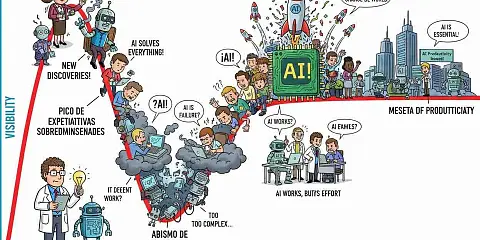
Do you want to be among the 5% who actually benefit from AI?

September 19, 2025
A couple of days ago someone sent me an excellent article by Esther Paniagua in EL ESPAÑOL. In it she gathers claims you may have heard in one outlet or another these past few days, echoing the fact that sources as solid (and as committed to technology) as MIT are publishing reports that talk about adoption failure rates of 95%. Enough gasoline to light the bonfire on which to burn all of us who have spent years trying to make people see that AI is here to change everything.
It doesn't worry me. At 62, this is my third or fourth bonfire. The first, which I lived through as a young professor pushing to bring computing into IE Business School, was that of the personal computer, so heavily called into question by the "productivity paradox" of Nobel laureate in Economics Robert Solow, who in 1987 stated that "you can see the computer age everywhere but in the productivity statistics". Years later, and this time right in the line of fire as the top executive of Terra in Spain, I lived through the bursting of the "dot-com bubble" and the autos-da-fé organized for those of us who said that technology would change the world forever. Today, from my seat as Chief Strategy Officer at Sngular, I once again see people making the same mistakes most fell into during previous technology waves.
What is surprising is that many executives, despite their experience of earlier stages, seem unfamiliar with concepts as fundamental as Gartner's technology adoption cycle (1995) or Rogers' innovation curve (1962). If they knew them, they would be able to distinguish between the financial maneuvering surrounding the emergence of a new technology platform and the impact that technology has on the reshaping of productive sectors.
To understand this better, it may be worth pausing for a moment to explain what a platform is, and more specifically a digital platform. Broadly speaking, a platform is an environment that serves as a foundation for developing, running or operating other elements. Digital platforms are virtual spaces that enable interaction between users and the provision of services or products over the Internet. Indeed, dear reader, this LinkedIn of our sins where you are reading me is a digital platform. One where Microsoft is going to make money thanks to my work writing these lines, but that's another story.
The battle of the giants
The importance of all this lies in the fact that the tech industry moves in cycles marked by platform shifts. From the PC we jumped to the web, and from there to smartphones. And in each of those leaps there were companies that bet on the change and proved right that "the winner takes it all" ABBA used to sing to us about. Microsoft built its empire in the PC era, Google or Amazon with the Web, Apple with smartphones, and what is at stake now is who will win the battle for control of the new platform, which is generative AI. We are talking, of course, about the big platforms; those foundations on which many other companies will deploy and operate new businesses or reinvent the ones they already had. The battle the media talk about is whether it will be Google with its Gemini or OpenAI with ChatGPT that ultimately becomes the dominant company of the next cycle.
The moves of these companies will result in a pile of burned money and ruined investors, but also in two or three big players who will have seized control of the next cycle and will have their prosperity guaranteed for many years.
The impact on everyone else
But there is another battle, much more interesting in the long run, which is about which companies, in each country and in each sector, will succeed in making the most of the possibilities offered by the new generative AI platform. In short, who will be part of that 5% of companies that are already starting to see results, and who will ride the new wave to improve their returns and their competitive position.
And I'm afraid that, as in previous waves, we are once again largely missing the point. Just ask any CEO or Chairman and they will tell you that they are "already deploying AI" and, at most, mention a specific pilot of something their CTO told them he was going to launch. Truly, if anyone thinks that buying a few Gemini, Copilot or ChatGPT licenses will let their company surf the new wave, they are as lost as those companies that, at the dawn of the Internet, built websites that almost always opened with the "Letter from the Chairman".
Can change be managed?
Faced with this confusing environment, some people think that a PMO (Project Management Office) "in charge of AI" will see us through with flying colors. Or, if we are a little more sophisticated, that it will be worth embarking on a VMO (Value Management Office) to get by. And I already consider it reasonable progress to examine whether we manage projects well (which is what a PMO does), or whether we are tackling the right projects to deliver business value (from the VMO). But when we are talking about a complete platform shift, like the one AI brings, that is not enough.
What needs to be done is to talk about strategy, to set up a group of experts capable of leading the change process by selecting innovative projects for their potential business impact, integrating all the necessary knowledge in areas such as data management, innovation, or the management of AI and technology. A group capable of leading, training, supporting best practices, and making sure the company's strategy takes advantage of the host of potential opportunities that come hand in hand with the change.
The new Centers of Excellence
These new organizational structures are neither PMOs nor VMOs, but Centers of Excellence, which help disseminate knowledge, mentor those who step forward, ensure that the right standards are used for the organization and that innovation happens in a way consistent with the business objectives we have set. They give the organization the set of tools needed to identify risks and opportunities, helping to mitigate the former and seize the latter. But they require a commitment from the company that goes far beyond a little cosmetic touch-up, showing up at CEO forums to brag about the cool things my CIO or my CTO tell me we're doing with AI.
The question is: do we want to be part of the 5% that rides this wave, or will we settle for a pilot and wait to be swept away by it? The time to talk about AI as an 'experiment' is over. It's time to make it a central piece of business strategy.
Are you clear on whether you are preparing properly for the next cycle?
PS: And yes, the image accompanying this article was generated by an AI and it isn't perfect. But ... how long would it have taken me to make something similar, when I'm unable to draw anything that doesn't look like it was painted by a two-year-old?
Our latest news
Interested in learning more about how we are constantly adapting to the new digital frontier?
Corporate news
October 7, 2026
Sngular grew by 7.2 per cent in the first half of 2026


Strategy
September 29, 2026
Would you hand your wallet to Zuckerberg?