
AI Agents and Data Governance: The Foundation of the New Technological Cycle

March 3, 2026
In recent years, we have seen a boom in Generative Artificial Intelligence. Today, we are seeing it in AI agents, and in the not-too-distant future, we will probably speak normally about physical AI or quantum computing.
But before looking that far ahead, let's talk about the present, about the current trend that everyone wants to adopt and that, nevertheless, most users and companies still don't know how to exploit correctly: Artificial Intelligence Agents.
🤖What are these agents and why are they the future?
Many of you may have already heard this term, but for those who are not familiar with it, in a very didactic way and to avoid going into technical details... I'll summarize it as follows: AI agents can be considered virtual assistants that, in addition to generating text, are capable of executing specific actions.
From an agent that can reserve a hotel room based on specific criteria, to another that is capable of simplifying and optimizing complex day-to-day tasks. The key is not only that they respond, but that they act.
Furthermore, agents allow for knowledge scaling. They capture human logic, context, and experience and put it to work continuously, without relying on repetitive manual processes, which makes them a key component of the digital future.
However, this future is not based on having increasingly sophisticated agents, but on something much more basic: that the agents properly understand the environment in which they operate. And that is only possible when data is governed and provides value.
It should also be noted that, in the current state of technology, it is essential to incorporate a human-in-the-loop approach. AI must act as an optimizer of our capabilities, not as an unquestionable authority.
🍋The Fruits of AI: Reaping the Harvest of Good Work
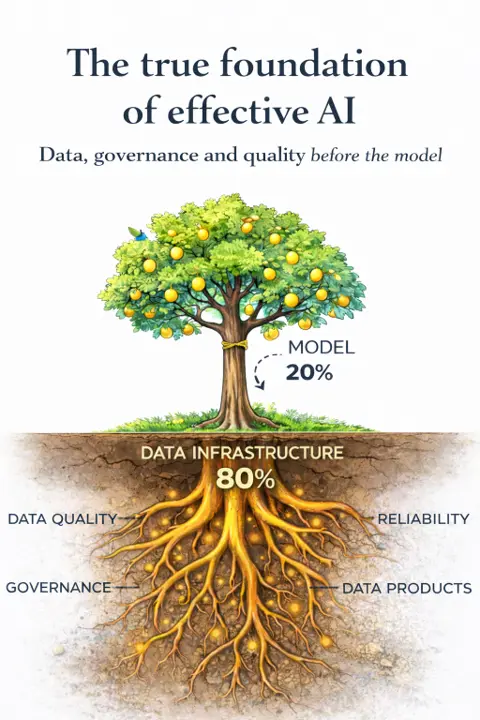
This image of the tree represents a simple idea, but one that is often not talked about much in the world of data: AI does not bear fruit without good roots. It bears fruit when a solid foundation of data, governance, and quality has been cultivated.
In the visible part of the tree, we find the model and its output—what everyone sees, what is usually shown in those executive presentations and reports. It is important, of course, but it represents only a small part of the real value. What would happen if those final results didn't really reflect reality? We would surely make bad decisions, and depending on the area we work in, they could have major repercussions.
The fruits that appear on the branches—automation, efficiency, better decisions, scalability—are not born solely from a good model, but underground; in fact, the quality of the fruit will depend on this foundation.
The roots, hidden from plain sight, symbolize that patient work that is often overlooked: defining coherent master data, establishing clear governance rules, ensuring data quality, and building reliable pipelines. Without these roots, the tree does not grow. And if it grows, it does not yield the fruits we expect.
The metaphor is clear: you cannot collect a good harvest without first tending to the soil. The organizations that are reaping good fruits with AI today are those that invested in doing well what was not seen. They are the ones who understood that governing data was not slowing down innovation, but preparing it.
This foundational work takes on even greater relevance in the current context, where Artificial Intelligence is beginning to operate under an increasingly defined legal and ethical framework. Initiatives such as the European Union's AI Act reinforce the need for governed, traceable data with clear meaning. There can be no responsible AI without understanding where the data comes from, how it is used, and under what rules decisions are made.
Ethics and awareness in the use of AI are not added at the end of the process; they are built from the roots. From data quality, transparency, explainability, and human supervision. Without this foundation, not only the value of AI is put at risk, but also trust, regulatory compliance, and the sustainability of solutions over time.
In this context, AI agents act as intelligent harvesters. They leverage what already exists, understand it, connect it, and put it to work, always supported by well-prepared ground.
🌳Paradoxical AI Agents: Can I Prepare the Ground with AI?
Now, preparing all this ground is not trivial. Building good roots, governed data, clear rules, and consistent quality has traditionally been a long, costly, and very manual job. It is no surprise that one of the most recurrent pain points in practically any organization is precisely preparing the ground for AI.
Paradoxically, it is Artificial Intelligence itself that offers us an opportunity to accelerate this process. Used judiciously, AI can help us build this ground more efficiently, orderly, and scalably.
Precisely for this reason, I have decided to simplify this manual work thanks to the help of AI. I would like to exemplify this topic with my own work. I am a Data Engineer specializing in data governance. I have had the opportunity to create and use Artificial Intelligence agents as direct support for my own work. Not as substitutes, but as accelerators under my continuous supervision, helping me to simplify, optimize, and structure tasks that have traditionally been complex, manual, and very time-intensive.
Based on this approach, I have developed four AI agents specifically focused on data governance, each tackling a fundamental pillar of data governance. Initially, these agents are designed to integrate within the Google Cloud Platform (GCP) ecosystem, specifically in Dataplex, although their design is flexible enough to be extrapolated to any other cloud platform, coexist in a GitHub repository, or even serve as the basis for a technology-independent data governance model.
The agents developed are:
-
Metadata Enrichment Agent: Focuses on enriching and giving meaning to existing data assets. It analyzes tables, views, and fields, and based on structured and unstructured information available in the organization, suggests functional descriptions, classifications, tags, and additional context. Its objective is to transform technical metadata into comprehensible, useful, and business-aligned information.
-
Business Glossary Agent: Acts as a semantic facilitator between business and technology. Based on knowledge distributed in documents, existing definitions, and actual data usage, it proposes the creation or enrichment of a coherent business glossary. It helps to identify key terms, potential ambiguities, and relationships between concepts, promoting a common language and reducing subjective data interpretation.
-
Data Quality Agent: Oriented towards the definition and continuous improvement of data quality. It analyzes the content and context of the data to suggest relevant quality rules from scratch, prioritizing those that truly provide value to the business. In this way, quality ceases to be reactive and becomes an element designed from the beginning of the data lifecycle.
-
Data Product Agent: Helps identify and structure data assets with the potential to become data products. Based on the analysis of their usage, stability, and relevance, it proposes definitions, responsibilities, and maturity criteria. Its objective is to align data with real business needs, avoiding the proliferation of datasets without a clear purpose.
Collectively, these agents allow for leveraging knowledge that is usually scattered across PDFs, spreadsheets, presentations, historical documents, structured in a database, etc., accelerating work that would otherwise take months to complete.
However, I emphasize not to misunderstand their purpose. It is not about blindly automating data governance or simply saying "ok" to everything they do. These agents act as intelligent assistants: they suggest, recommend, and structure, but always within a human-in-the-loop approach, where people still have the final say. We review, validate, and decide with our own judgment based on our knowledge and experience. Intelligence emerges from the collaboration between human experience and the ability of AI to organize, connect, and accelerate.
Our latest news
Interested in learning more about how we are constantly adapting to the new digital frontier?
Corporate news
October 7, 2026
Sngular grew by 7.2 per cent in the first half of 2026


Strategy
September 29, 2026
Would you hand your wallet to Zuckerberg?