
Your company is already talking about AI. Now it’s time to decide where to start.

November 4, 2026
You’ve spent months attending webinars, trying out tools and sharing news about agents in the company chat. Someone posts a demo that puts reports together. Someone else shares an agent that seems capable of running an entire department. There’s enthusiasm, several experiments underway and a folder of links that now deserves its own manager.
Then comes a rather less spectacular question. Who’s going to use all this on Monday, and what for? Cue silence. Or a meeting to discuss it.
It’s understandable. Updates arrive fast, and it’s hard to tell what deserves your attention. There’s also that feeling that we should be doing more, especially when every other company seems to have it all figured out. Although a demo tells you very little about what happens once the projector is switched off.
Experimenting helps us learn. But there comes a point when it’s worth looking closely at everyday work and choosing something worth improving.
Identifying what’s holding us back
The other day, during a Marketing team meeting, we were discussing how to take our use of AI a step further. We already use it to prepare campaigns, develop copy, explore ideas and analyse information. We’re fortunate to work at a company that encourages its use through training, tools and opportunities to get involved in new AI projects, so the willingness to experiment comes fairly naturally.
But our work is spread across several tools. We organise tasks and projects in Jira, manage communications campaigns through a Microsoft tool, keep briefs and documentation in Google Drive, and find much of our information about potential customers on LinkedIn.
Meanwhile, each tool is introducing its own AI, and everyone on the team works with their own assistants, instructions and conversations. We’re finding ways to complete individual tasks faster, although the context and lessons learned don’t always reach the rest of the team.
We have plenty of help. What we still do ourselves is connect all the pieces. Move information from one tool to another, check that we’re working with the latest version, and explain context we’ve already provided somewhere else. Each step seems small, but together they eat into the time we were hoping to save.
That’s when agents came into the conversation. If everyone is adopting AI in their own way, with different levels of experience, how can we build on what we’ve learned to work better together? We want the information and resources we’ve been creating to benefit the whole team, helping us take on more initiatives, give strategy more attention and think more carefully about what we do.
But we still don’t know how to organise it. What would make sense to centralise, which tools we’d need to connect, or which tasks could become part of the same workflow. We’re also unsure where an agent would add the most value and where simply reviewing how we organise our work would be enough.
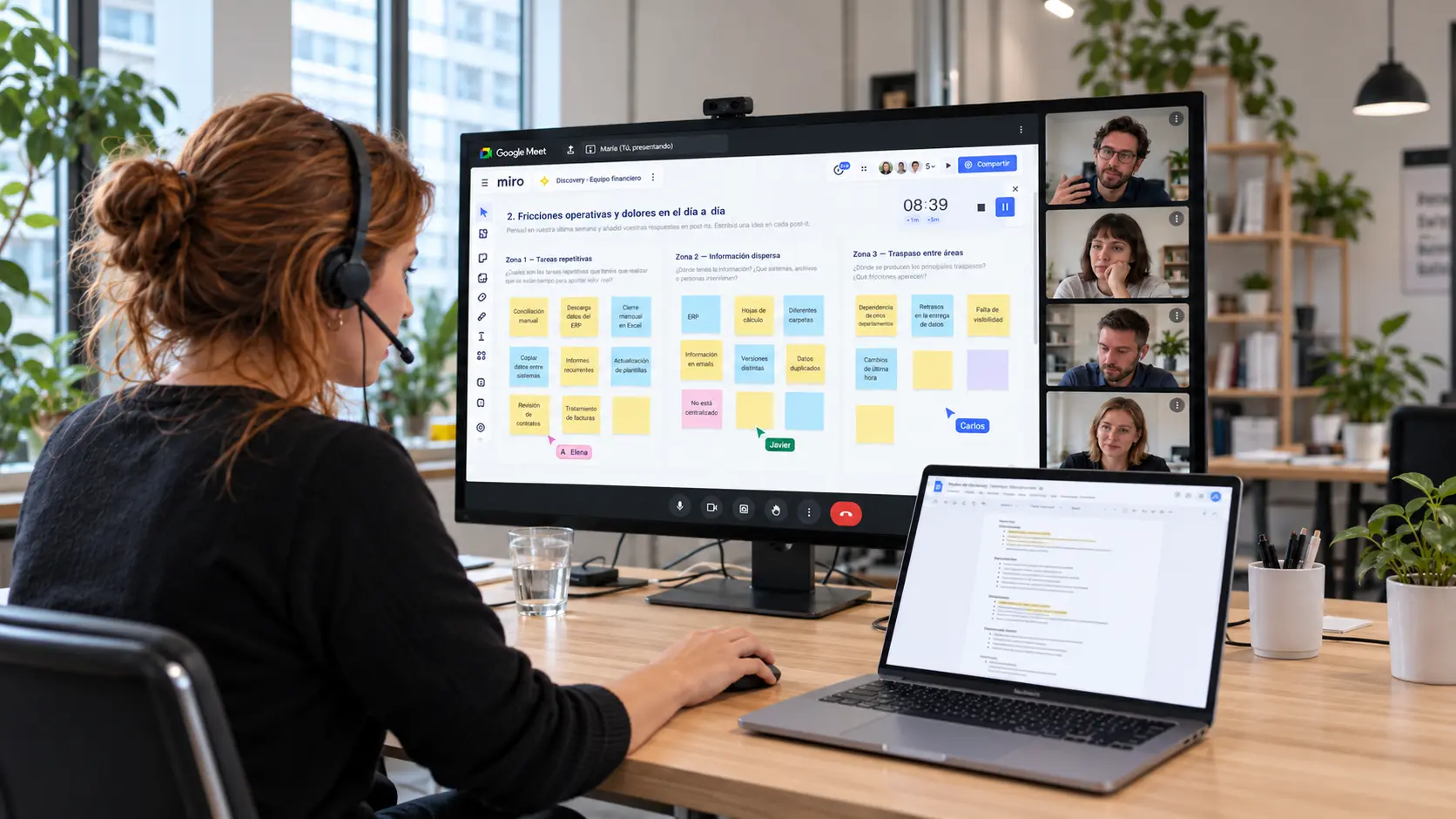
To move forward, we needed to step back and look at the whole process. That led us to sit down with our Research team for a discovery session: a working session to understand how we organise ourselves, identify where time or context gets lost, and prioritise opportunities for improvement. A starting point for moving from individual initiatives towards a more coordinated way of working, with a shared understanding of what to tackle first and for whom.

A discovery session to decide where and how to apply AI
When you work within a process every day, you get used to its little bottlenecks. You know whom to ask, where to look for the missing file and which approval needs chasing in the chat. Until someone from outside asks why you do it that way, and a familiar answer comes up. “Well, that’s how we’ve always done it.”
A discovery session gives you the chance to pause and examine that work with some perspective. The Research team facilitates a conversation with the people involved to understand what they need, how they work and where they encounter difficulties. It starts with specific situations—the kind that rarely feature in a product demo.
In our case, that would mean following a campaign from start to finish and bringing together what each person sees from their part of the process. We might discover that several of us are searching for the same information. That each assistant receives different instructions about our brand. Or that a seemingly simple task gets stuck because it depends on data spread across three tools.
That’s where we start to define the help we need from AI. We can assess which tasks would make sense to connect, what information an agent would need and which decisions should remain with the team. We can also distinguish what we could test soon from what requires other dependencies to be resolved first.
With that information, we can address another common question. Which AI tool best fits our needs? Is an assistant enough for certain tasks, or do we need a shared environment connecting information, tools and agents? Understanding how we work allows us to compare options thoughtfully, taking into account the applications we already use, access permissions and the team’s needs.
The value of discovery lies in leaving with a shared basis for moving forward. Choosing an opportunity worth exploring, understanding what it requires and using that knowledge to guide our choice of technology for testing the idea.
If your team is also trying to define that first step, we’ve put together a webinar on identifying where to start with AI, where we’ll continue this conversation. It could be a useful opportunity to look at your everyday work through a different set of questions and start making sense of all the possibilities.
From discovery to agents. Why Google
Discovery might lead us to connect tools, review a process or develop an agent. Once our needs are clearer, we can choose the technology. And among the options worth exploring is Google’s new offering.
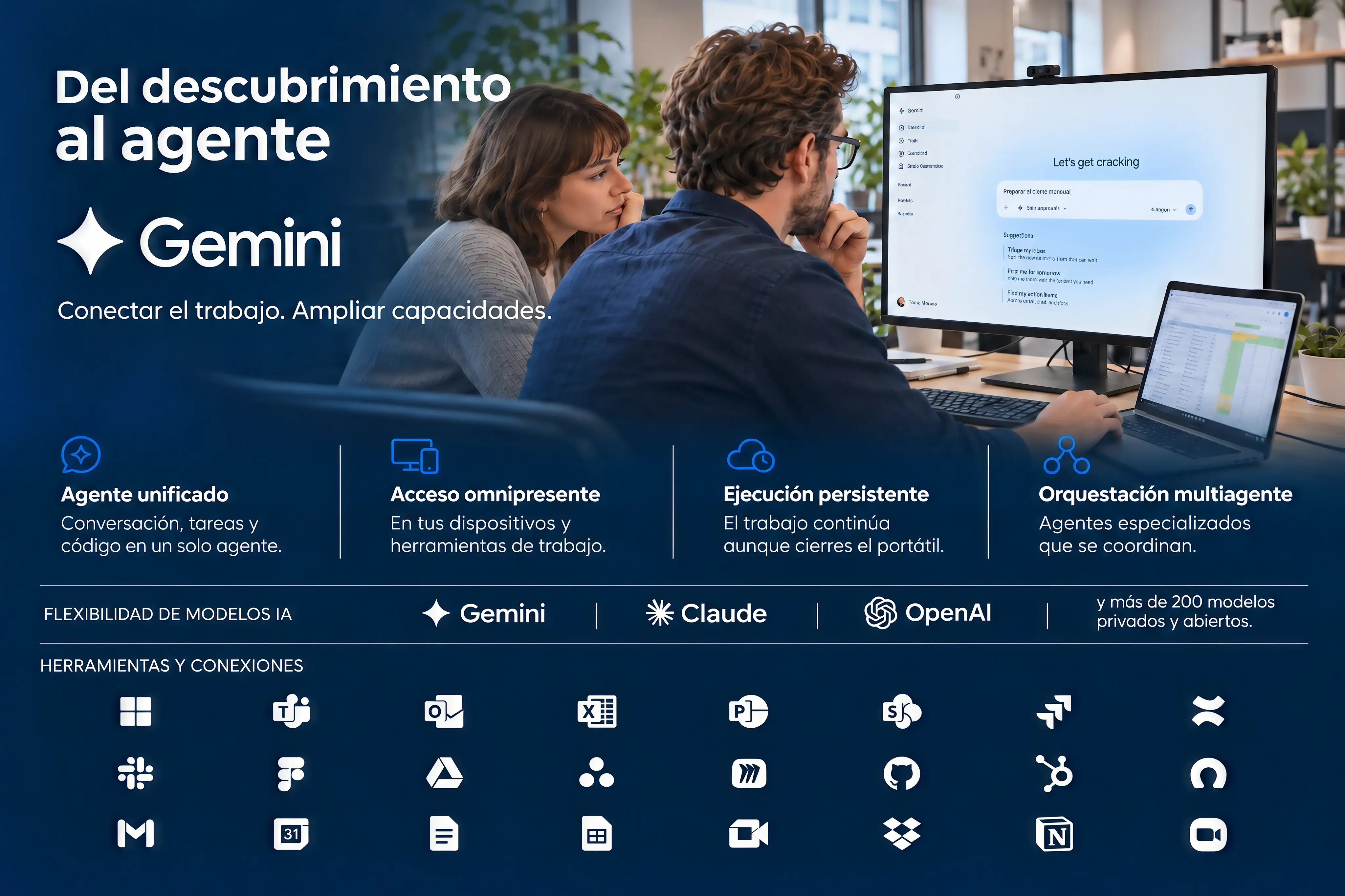
At Gemini at Work, Google introduced an evolution of its AI for work, bringing models, tools and agents together in a more integrated environment. Gemini can take an objective, plan the steps and coordinate specialised agents to complete it. It retains context across devices and can keep working in the cloud even after we close our laptops.
It also offers greater freedom to choose models. Google Cloud’s enterprise platform provides more than 200 first-party, third-party and open models. The agent can use Gemini and Claude according to each task’s needs, balancing capability and cost. OpenAI models have begun rolling out in Model Garden through a private preview, with availability in the agent planned.
For our Marketing team, what matters is how we could connect those capabilities with the tools we already use, such as Workspace, Microsoft 365 or Jira. We could explore a workflow that starts with an approved brief, gathers documentation and prepares drafts for different channels, ready for our review. Skills—reusable instructions with references and examples—would let us incorporate our brand voice and working guidelines, and share them with the team where the available settings allow.
That autonomy comes with enterprise controls, including access permissions, activity logs and isolated execution environments. Payment options include per-user and consumption-based plans, depending on the edition and availability, alongside project spending caps that can pause the agent when reached.
The possibilities extend beyond Marketing. In People, we could explore preparing for a new starter; in Sales, gathering background for a meeting; in Procurement, assembling the documentation needed to compare bids.
Each application requires its sources, integrations and review steps to be validated. The aim is to expand the team’s capabilities and regain time to think and make better decisions. Discovery helps us choose where to test the approach and assess whether Gemini fits.
From so many possibilities to a first step
Your team may already have ideas, tools and the motivation to move forward with AI. If what’s missing is a decision about where to focus, join us as we continue this conversation in our webinar “AI agents, yes. But where do I start?”.
We’ll explore how discovery helps identify where AI can add value and how to take the next steps with Gemini. We’ll also show a demo of Gemini connected to Atlassian and Microsoft, particularly relevant for teams whose information and tasks are spread across both ecosystems and who want to benefit from AI while continuing to use their existing tools.
Our latest news
Interested in learning more about how we are constantly adapting to the new digital frontier?
Corporate news
October 7, 2026
Sngular grew by 7.2 per cent in the first half of 2026


Strategy
September 29, 2026
Would you hand your wallet to Zuckerberg?