Medical Imaging Interoperability Platform: An Infrastructure for Sharing, Integrating and Reusing Imaging Studies

September 22, 2026
A medical imaging interoperability platform is a cloud-based or hybrid infrastructure that centralizes and distributes DICOM radiology studies by connecting PACS, VNA and electronic health record systems. It enables healthcare organizations and clinical teams to reuse imaging studies for second opinions, referrals, telemedicine and artificial intelligence applications without having to build a separate integration for every use case.
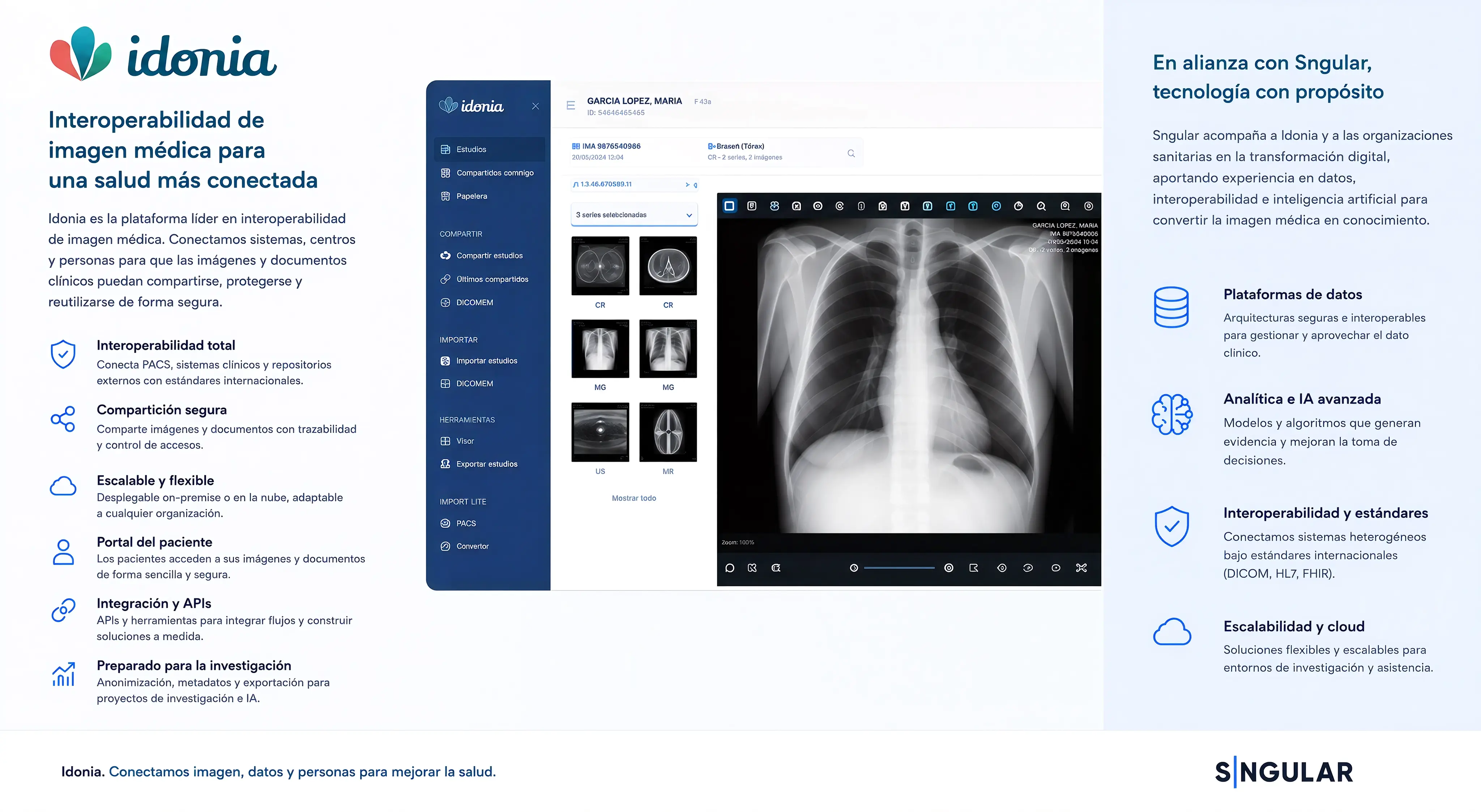
By combining Idonia’s technology with SNGULAR’s integration capabilities, healthcare providers can shorten response times, reduce manual administrative tasks and maintain full traceability across every exchange. Through an API-based architecture and secure access controls, professionals can access the complete lifecycle of an imaging study from an integrated web viewer, turning every diagnostic image into a reusable digital asset for the wider healthcare ecosystem.
A medical imaging interoperability platform makes it possible to reuse the same study for second opinions, referrals, telemedicine, artificial intelligence and data analytics.
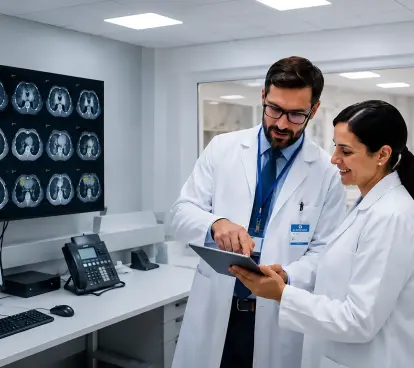
A medical imaging study does not stop being useful once the radiology report has been signed. That is simply its first use. The same MRI scan can later be used to monitor the progression of a lesion, support a second opinion, accompany a referral, be reviewed by a telemedicine team or be processed by an artificial intelligence algorithm.
The challenge arises when each new use requires teams to retrieve files, create new access permissions or develop a different integration. The image already exists, but it remains tied to the system for which it was originally generated.
Medical imaging management therefore goes beyond the PACS. It must also address how each study moves between systems, who is allowed to use it and how the resulting information is returned to the clinical workflow. This is what transforms an isolated diagnostic study into a reusable asset within the hospital’s digital ecosystem.
The same study can continue to deliver value beyond the initial diagnosis
An MRI, X-ray or CT scan is not useful only for making an initial diagnosis. The original images may need to be reviewed again when a patient requests a second opinion, continues treatment at another hospital or needs to be assessed by a specialist team.
The same images can also be sent to an artificial intelligence solution for analysis and then returned with additional information to support the clinician. This makes it possible to introduce new diagnostic capabilities without repeating the examination or removing it from its clinical context.
The key is ensuring that the images can be reused across all these processes without losing information, security or traceability. A medical imaging platform enables that continuity and avoids having to create a separate workflow for every new use case.
A medical imaging interoperability platform as a common layer
Archiving systems play an essential role within hospitals by storing and organizing diagnostic studies. The challenge begins when an image needs to leave that environment or become part of a process involving other applications or organizations.
A medical imaging interoperability platform provides a common layer for managing these exchanges. Patients, referral workflows, telemedicine services and AI solutions can therefore reuse the same infrastructure, access controls and traceability mechanisms.
The value of this approach goes far beyond simply transferring DICOM files. The platform identifies the relevant study, authorizes access, preserves its clinical context, delivers it to the appropriate destination and records what happened throughout the process. It can also integrate with PACS, VNA, electronic health records, patient portals and other enterprise applications.
Idonia: from delivering medical studies to connecting their entire lifecycle
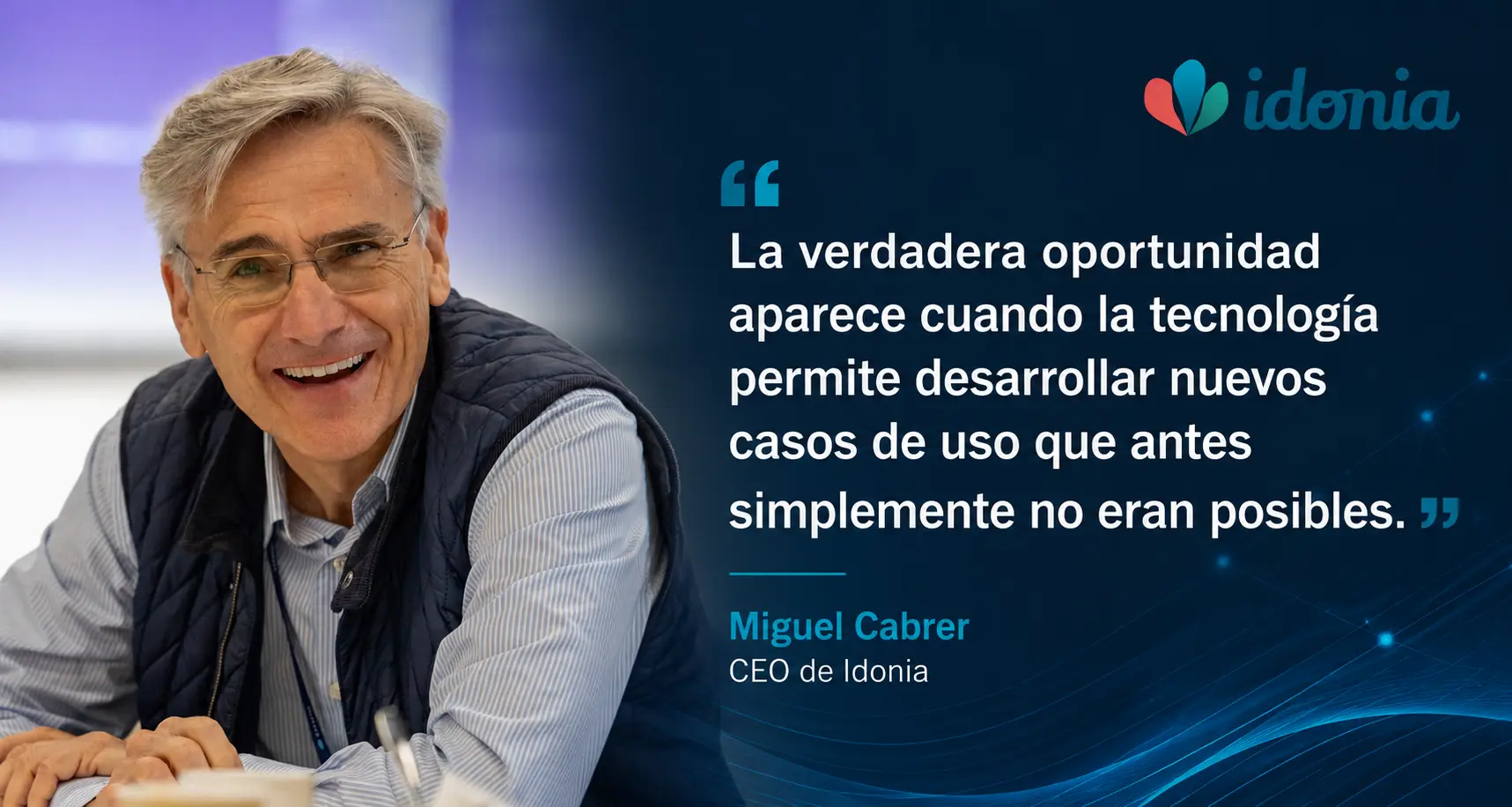
Idonia was founded in 2017 with the goal of making medical images and reports easier to access and distribute. Miguel Cabrer, the company’s CEO, explains that the original challenge was to improve access to information that was difficult to use outside hospitals’ internal systems.
In response to that need, Idonia developed a cloud-native platform that can also operate in on-premise or hybrid environments. Its service- and API-based architecture allows it to connect with third-party applications without replacing existing clinical systems.
Miguel summarizes the company’s activity with a simple idea: “What we do is medical imaging transactions.” These transactions include delivering studies to patients, exchanging images between healthcare organizations, managing referrals, supporting telemedicine and connecting clinical systems with artificial intelligence algorithms.
Idonia is therefore more than a repository or an image viewer. It connects the different destinations and uses of an imaging study through a reusable infrastructure.
From patient portals to artificial intelligence
Within a patient portal, an integrated viewer allows patients to access their images without installing additional software or dealing with unfamiliar file formats. The same infrastructure can generate secure access links and make it easier to share a study with another healthcare professional.
In a referral process, the originating healthcare provider can make the study available to the receiving organization while maintaining full traceability. In telemedicine, the study becomes part of the remote care workflow without relying on someone manually locating and uploading the files.
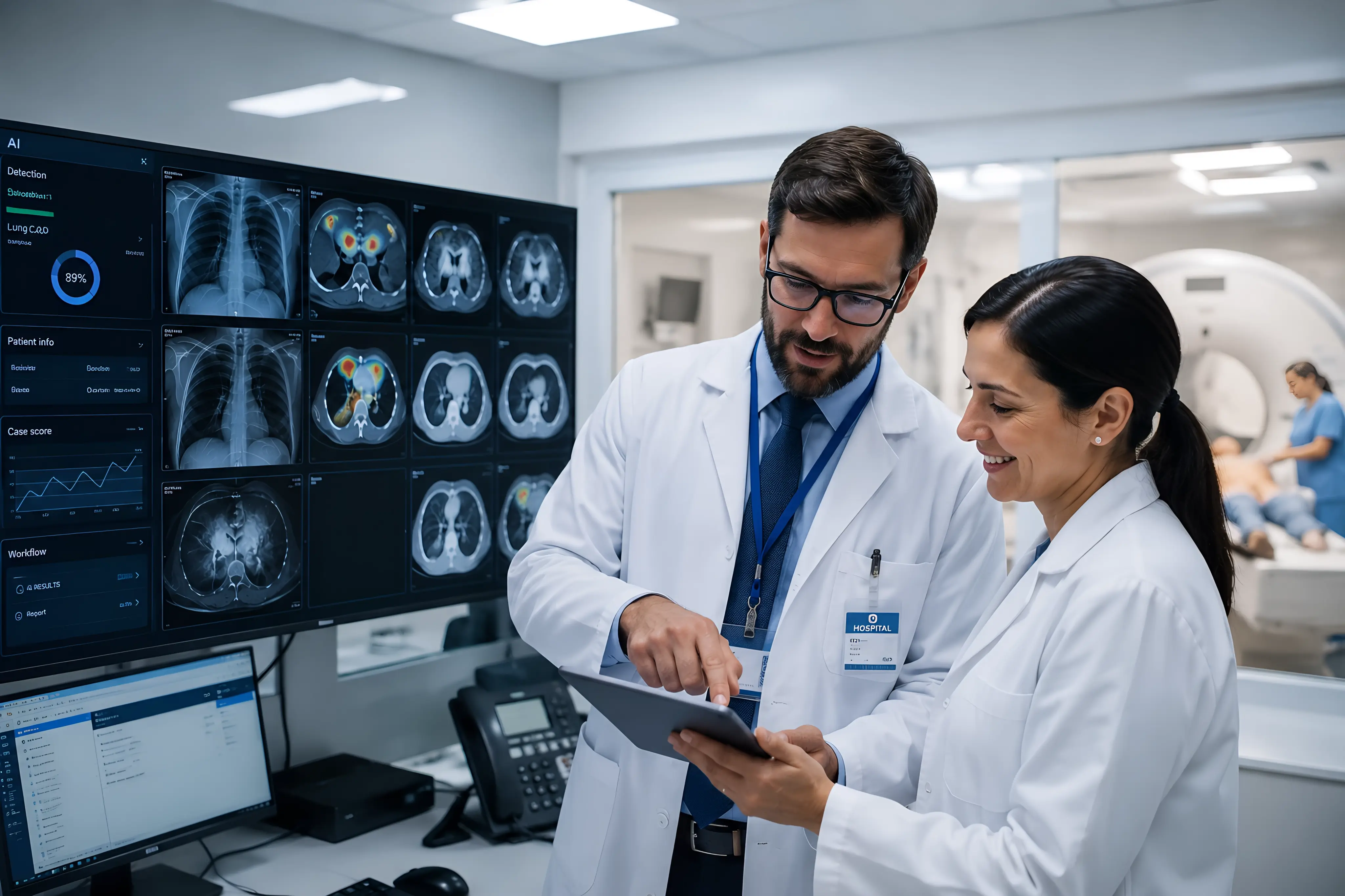
Artificial intelligence orchestration follows a similar principle. Idonia can connect third-party algorithms with clinical systems, sending studies for analysis and returning the resulting information. This means hospitals do not need to build and maintain an independent integration for every AI provider and can instead preserve a more open and flexible architecture.
Clinical research represents another potential use case, provided that appropriate consent, anonymization, security and data governance mechanisms are in place.
The data generated around medical images
An MRI scan also generates valuable operational data around it: how long a referral takes, which healthcare organizations exchange the highest number of studies or where manual tasks are creating bottlenecks.
As Miguel Cabrer explained during his conversation with SNGULAR, “Everything we do generates a trace,” and organizing that information creates “enormous potential.” Idonia captures the information generated by these transactions; turning it into actionable knowledge requires integrating it with other data and connecting it to the specific questions each organization wants to answer.
This does not necessarily mean analyzing the clinical content of the images themselves. It can also mean understanding the processes surrounding them. A dashboard, for example, could show response times, service adoption, referral volumes or recurring incidents. This information can help organizations prioritize investments and assess whether a new capability is actually improving care.
Sharing an imaging study also means sharing clinical insight
Collaboration between hospitals depends on professionals being able to access the same information, at the right time and with enough context. In a referral, second opinion or multidisciplinary team meeting, the radiology report alone may not be enough. Specialists may need access to the original images so they can review the study themselves and compare it with the patient’s clinical progression.
When this access depends on email, physical media or manual uploads, clinical collaboration slows down. The receiving organization may struggle to open the study, incorporate it into its systems or identify the correct version. Healthcare professionals then end up spending part of their time locating and managing information instead of analysing it.
A shared infrastructure allows clinicians at the originating organization to make a study available directly to the specialist responsible for reviewing it, while maintaining access control and traceability. The receiving clinician can examine the images before the consultation, prepare the case more effectively and respond more quickly, without requiring the patient to act as an intermediary.
This model is particularly useful in hospital networks, referrals between public and private providers, oncology boards, complex-care pathways and telemedicine services. Medical images are no longer tied to a single organization; instead, they become part of a broader clinical conversation.
Sngular’s role: integrating and building on top of the platform
Idonia provides the specialized infrastructure required to manage medical imaging transactions. Sngular’s role is to integrate that infrastructure into each organization’s technology ecosystem and build services on top of it that address specific business and clinical needs.
This includes integration with PACS, VNA, electronic health records, identity systems, patient portals and applications, as well as the design of data platforms, analytics models and architectures ready to incorporate artificial intelligence.
Idonia brings deep expertise in the medical imaging domain and provides the traceability layer. SNGULAR adds capabilities in integration, data, cloud and digital product development.
The platform becomes significantly more valuable when it is embedded into everyday workflows and when the data it generates can be used to improve decision-making, automate tasks or create new services without introducing yet another technology silo.
For healthcare organizations, this collaboration makes it possible to launch new medical imaging services faster and with lower integration risk. The solution builds on existing systems, enables collaboration between hospitals and healthcare professionals, improves patients’ access to their studies and maintains traceability across every exchange.
It also establishes a common foundation for analytics, automation and artificial intelligence, without creating additional silos or unnecessarily increasing technological complexity.
A medical study can continue to deliver value
An MRI may begin by answering a specific clinical question, but its journey does not have to end there. It can help another specialist, accelerate a referral, support a remote-care service, feed an algorithm or provide information that helps improve a clinical or operational process.
For this to happen, medical images need to be connected to an infrastructure capable of supporting different uses while maintaining security, context and control.
Idonia provides the specialized layer required to move and connect medical imaging studies. SNGULAR integrates that layer with the hospital’s wider technology ecosystem and helps transform the activity it generates into new digital capabilities.
That is the new life of a medical imaging study: moving beyond being a static file and becoming a useful resource throughout its entire lifecycle.
About this content
This article was produced by SNGULAR following a conversation with Miguel Cabrer, CEO of Idonia, whose experience and perspective on interoperability, medical imaging and innovation provided the foundation for this discussion.
Rather than focusing solely on a specific technology solution, the aim of this article is to open a broader conversation around one of the major challenges facing the healthcare sector: how to build an infrastructure capable of connecting organizations, data and technology in order to improve patient care and accelerate innovation.
The collaboration between Idonia and SNGULAR is built around that shared vision. Idonia provides a specialized platform for the secure exchange of medical imaging and interoperability between healthcare organizations, while SNGULAR contributes its capabilities in integration, data platforms, cloud and artificial intelligence to help that infrastructure generate greater value for hospitals, healthcare groups and the wider healthcare ecosystem.
Our latest news
Interested in learning more about how we are constantly adapting to the new digital frontier?
Insight
July 30, 2026
How to Share Medical Images Between Hospitals and Give Patients Easier Access to Their Scans

Event
November 24, 2025
White Mirror 2025: the blank mirror reflecting what is yet to come

Event
October 20, 2025
Sngular is heading to the Global Health Exhibition 2025 in Riyadh, Saudi Arabia

Event
May 26, 2025
Madrid pulses with the new era of Artificial Intelligence at the Google Cloud Summit 2025